

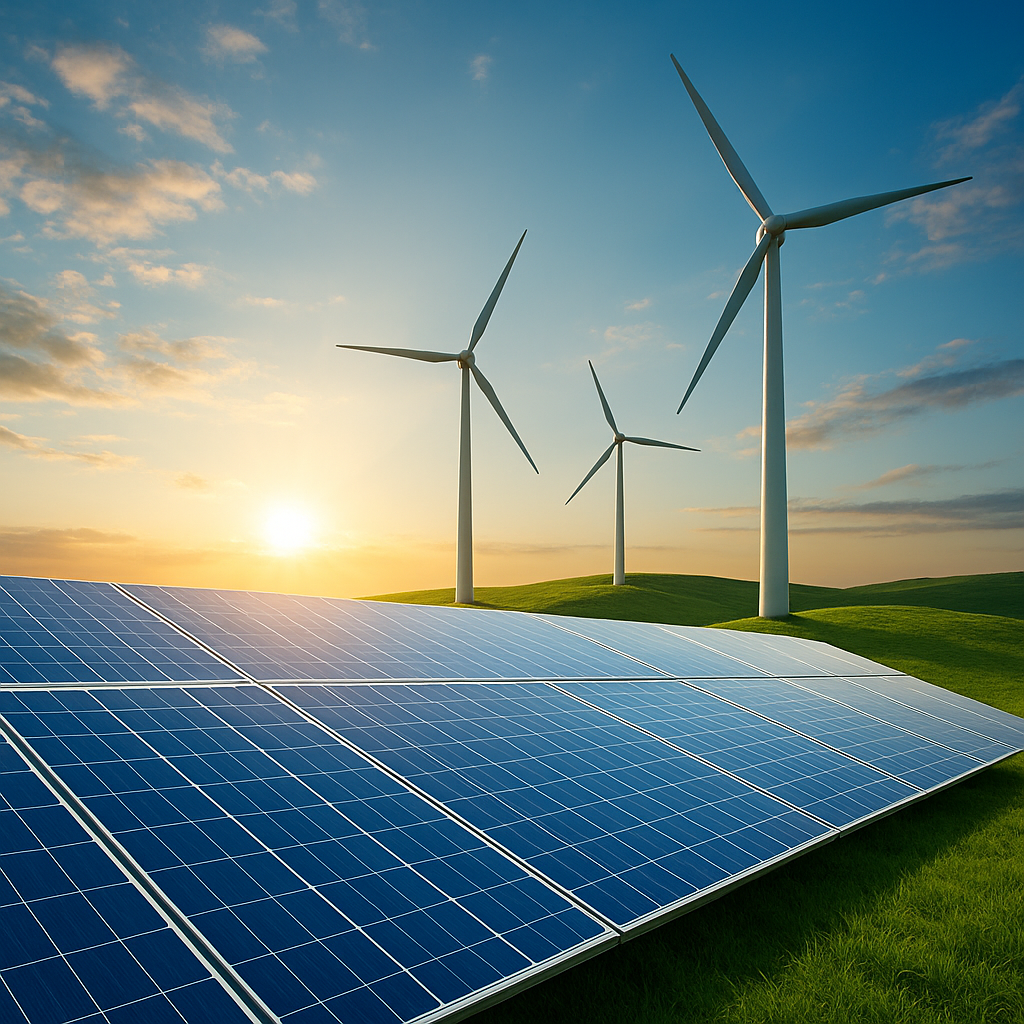
Renewable Energy benefits for a Sustainable Future
Introduction:
We’re standing at a turning point. In 2025, renewable energy isn’t just about saving the planet — it’s about redefining how humanity powers its future. Every country, business, and individual faces one clear truth: fossil fuels are fading, and the renewable era is here to stay.
From massive solar farms in deserts to offshore wind turbines spinning on the horizon, renewables are reshaping economies, protecting ecosystems, and creating millions of jobs. The shift is no longer optional — it’s essential for survival, sustainability, and shared prosperity.
⚡ What Exactly Is Renewable Energy?
Renewable energy comes from sources that naturally replenish themselves, such as sunlight, wind, water, and organic matter. Unlike coal, oil, or gas, renewables don’t run out and produce little to no pollution.
🔋 Types of Renewable Energy
| Energy Source | Description | Key Benefit |
|---|---|---|
| ☀️ Solar Power | Converts sunlight into electricity | Most abundant energy source on Earth |
| 🌬️ Wind Power | Uses air currents to spin turbines | Highly scalable and cost-efficient |
| 💧 Hydropower | Harnesses water flow from rivers or dams | Reliable base-load energy |
| 🌱 Biomass | Uses organic waste to produce fuel | Reduces waste and supports circular economy |
| 🌋 Geothermal | Utilizes Earth’s internal heat | Continuous, low-emission energy |
🌿 The Core Benefits of Renewable Energy for a Sustainable Future
Let’s go beyond the basics and look at why renewables are the backbone of a sustainable planet — environmentally, economically, and socially.
1. Renewable Energy Protects the Planet
The energy we choose determines the planet’s future. Fossil fuels release billions of tons of CO₂ yearly, accelerating climate change. Renewables, on the other hand, provide clean, emission-free power.
-
According to the IEA’s 2025 Global Energy Outlook, renewables could reduce global carbon emissions by up to 70% by 2050.
-
Solar and wind energy now produce electricity 70% cheaper than coal in most regions.
Example: The UK’s 2024 wind expansion prevented over 30 million tons of CO₂ emissions, equivalent to planting 1.5 billion trees.
2. It Powers Economic Growth and Green Jobs
The renewable sector is not just about saving the planet — it’s a profit engine. In 2025, the global renewable energy industry exceeds $2 trillion, employing millions worldwide.
Key Statistics:
-
IRENA (2024) reports over 38 million green jobs expected by 2030.
-
Every $1 million invested in renewables creates three times more jobs than fossil fuels.
-
India’s National Solar Mission alone added over 1.2 million jobs in the last decade.
These jobs span from solar installation and engineering to AI-powered energy analytics, proving that renewables can empower economies and communities simultaneously.
3. It Strengthens Energy Independence
Energy independence means freedom — freedom from price hikes, wars, and supply disruptions.
Countries investing in renewables reduce reliance on imported oil and gas, securing their energy future.
Case Study:
-
Germany’s Energiewende policy enabled the nation to produce over 50% of its power from renewables.
-
Morocco’s Noor Solar Complex, one of the largest in the world, now powers over 2 million homes, slashing its import costs dramatically.
This autonomy builds economic stability and political resilience — a foundation for long-term sustainability.
4. Innovation Is Supercharging the Renewable Revolution
Technology is the secret weapon of renewable energy’s unstoppable growth.
In 2025, we’re witnessing breakthroughs that make clean power cheaper, faster, and more reliable than ever.
Key Innovations:
-
AI & Machine Learning: Predicts power demand and weather patterns for efficient grid balancing.
-
Energy Storage Advances: New solid-state and hydrogen batteries are solving the intermittent power challenge.
-
Smart Grids: Real-time energy flow tracking ensures zero wastage.
-
Solar Efficiency: New perovskite solar cells reach 45% efficiency, doubling traditional panels.
These innovations make renewables smarter, scalable, and future-proof — key ingredients for long-term success.
5. Boosting Community Resilience and Social Equity
Renewables democratize energy access. In remote and underserved communities, solar and wind projects provide affordable, off-grid power that transforms lives.
-
Africa’s off-grid solar programs now provide clean power to 600 million people.
-
Community-owned energy cooperatives in Europe let citizens profit from local solar farms.
-
Microgrids in rural Asia reduce blackouts and support local businesses.
This empowerment model not only cuts poverty but also enhances education, healthcare, and entrepreneurship — the social pillars of sustainability.
Challenges of Renewable Energy (and Smart Ways to Fix Them)
No transition is perfect. The road to full renewable adoption comes with hurdles — but they’re solvable.
⚠️ 1. Storage and Reliability
Renewables depend on natural conditions — no sun, no solar.
✅ Solution: Advanced energy storage systems and hybrid grids are already stabilizing renewable output worldwide.
⚠️ 2. Infrastructure Costs
Large-scale wind farms and transmission networks can be costly.
✅ Solution: Falling installation prices (down 80% since 2010) and green government incentives make renewables more affordable each year.
⚠️ 3. Policy and Market Barriers
Some countries lack clear energy transition policies.
✅ Solution: Global frameworks like the Paris Agreement and COP28 clean energy pledges are accelerating cross-border collaboration and funding.
Real-World Examples of Renewable Success (2024–2025)
| Country | Initiative | Result |
|---|---|---|
| 🇳🇴 Norway | 98% hydroelectric power | Near-total carbon neutrality |
| 🇨🇳 China | 300+ GW solar installations | World leader in clean capacity |
| 🇺🇸 United States | Offshore wind farms expansion | 25% growth in clean power generation |
| 🇮🇳 India | National Solar Mission | 70 GW solar capacity in 2025 |
| 🇰🇪 Kenya | Geothermal dominance | 90% clean power grid |
Insight: Every continent is proving that renewables aren’t just “green”—they’re economically unstoppable.
The Connection Between Renewable Energy and Waste Reduction
Sustainability doesn’t stop at clean energy. It’s also about responsible resource use.
Renewables and plastic waste management work hand in hand to build a circular economy — one where nothing goes to waste.
Example Synergy:
-
Solar-powered recycling plants reduce industrial waste.
-
Biogas from organic waste becomes clean fuel.
-
Plastic waste can be converted into energy via pyrolysis — closing the waste loop sustainably.
Together, renewable energy and waste management represent the two engines of true sustainability.
The Economic Ripple Effect: Renewables Reshape the Global Market
Renewable adoption has become a competitive advantage.
Companies investing in green power attract ESG-focused investors, gain consumer trust, and reduce long-term costs.
Business Impact:
-
Amazon runs the world’s largest corporate renewable energy portfolio.
-
Apple powers all global offices and stores with 100% renewables.
-
Tesla drives renewable integration through solar energy and EV storage.
This global transition is rewriting corporate responsibility standards and driving a green industrial revolution.
The Future of Renewable Energy (2025–2040)
By 2040, experts predict:
-
Renewables will provide 70% of the world’s electricity.
-
Battery costs will fall by another 60%.
-
AI-powered smart grids will reduce energy waste by 40%.
-
Over 80 countries will achieve net-zero energy systems.
In short: the clean energy tipping point has already arrived — and 2025 marks the beginning of an unstoppable era.
FAQ Section
Q1: Why is renewable energy important for the future?
It ensures environmental sustainability, energy security, and long-term economic growth.
Q2: Which renewable energy source is most efficient?
Hydropower remains the most consistent, but solar and wind are now the most scalable.
Q3: How does renewable energy reduce plastic waste?
It powers recycling processes and supports a circular economy that reduces waste-to-landfill.
Q4: What’s the global renewable energy target by 2030?
The UN aims for renewables to provide at least 60% of global electricity by 2030.
Q5: Can renewable energy end fossil fuel use completely?
Yes, with advancing technology and global cooperation, a fossil-free future is within reach.
Conclusion: Building a Resilient, Renewable World
Renewable energy isn’t just an alternative — it’s the foundation of a sustainable, secure, and equitable future.
From powering cities to uplifting rural lives, renewables drive a cleaner, fairer, and more resilient world.
As we move deeper into 2025, every investment in clean energy is an investment in hope, progress, and human survival. The time to act isn’t tomorrow — it’s now.
Share this article to inspire others to join the renewable revolution.


