

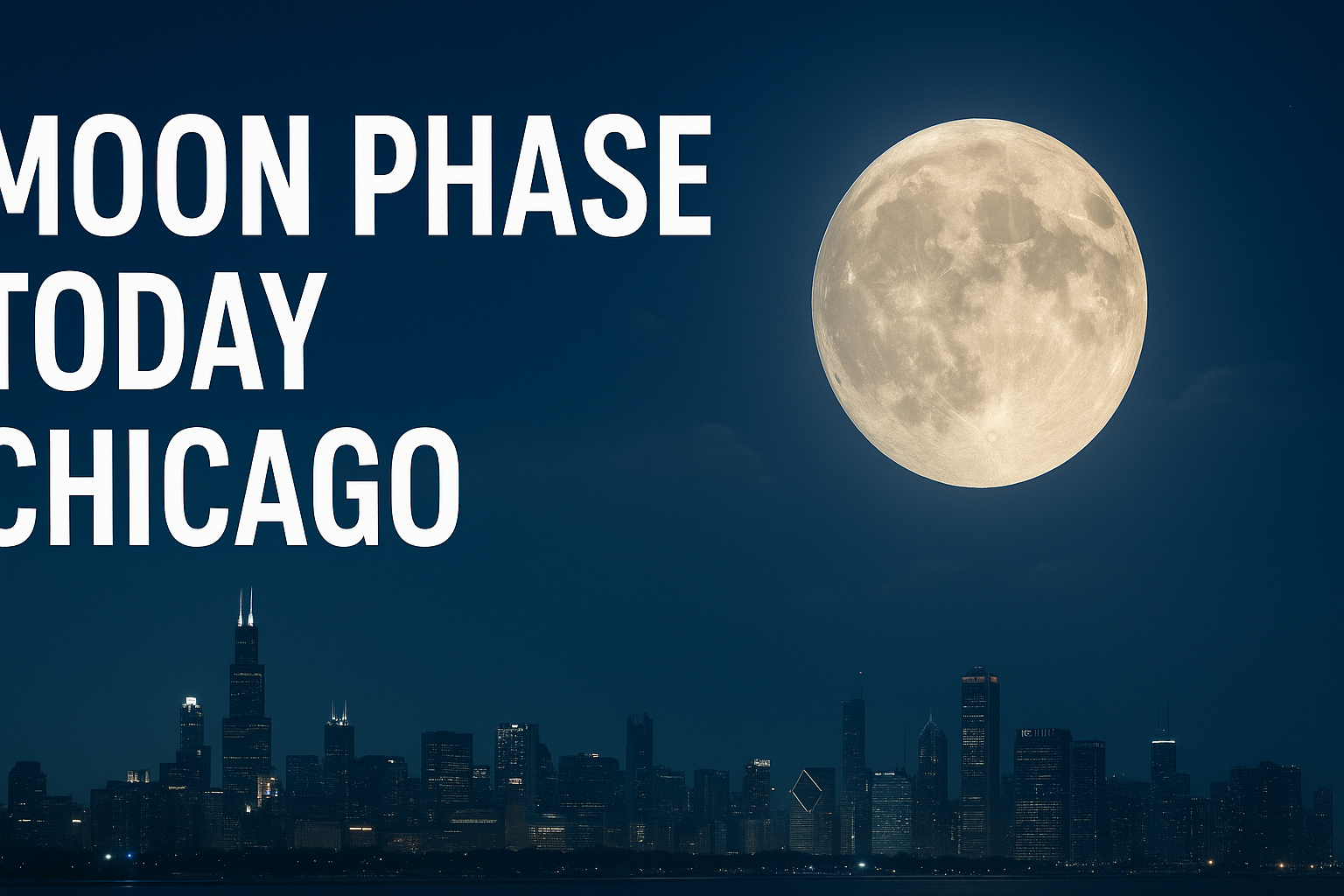
Moon Phase Today Chicago: Live Updates & Tonight’s Lunar Guide 2025
Introduction:
Have you looked up at the Chicago skyline tonight and wondered what phase the moon is in? Whether you’re a passionate stargazer, photographer seeking the perfect lunar shot, or simply curious about tonight’s celestial display, understanding the moon phase today in Chicago gives you the astronomical knowledge you need.
Chicago’s unique position along Lake Michigan creates stunning moonrise views that combine urban architecture with natural beauty. Tonight’s lunar phase affects everything from tide patterns to wildlife behavior and knowing exactly what’s happening above can enhance your appreciation of our cosmic neighbor.
READ MORE NEWS ARTCLE HERE
Understanding Today’s Moon Phase in Chicago
The moon phase today in Chicago represents a specific point in our natural satellite’s 29.5-day lunar cycle. As of December 4, 2025, observers in the Windy City can witness the moon’s current illumination and position based on Chicago’s Central Time Zone location.
Moon phases progress through eight distinct stages: new moon, waxing crescent, first quarter, waxing gibbous, full moon, waning gibbous, last quarter, and waning crescent. Each phase lasts approximately 3.7 days, creating the continuous cycle that has fascinated humanity for millennia.
Chicago’s latitude at 41.8781°N and longitude at 87.6298°W places the city in an ideal position for lunar observation. The moon’s path across Chicago’s sky varies throughout the year, with summer moons traveling lower across the southern horizon and winter moons taking a higher trajectory.
Understanding the current moon phase in Chicago helps photographers plan golden hour shots, gardeners time their planting schedules according to lunar gardening principles, and astronomy enthusiasts coordinate observation sessions. The moon’s brightness during different phases dramatically affects stargazing conditions throughout Illinois.
Current Moon Phase and Illumination Details
Tonight’s moon phase in Chicago shows specific illumination percentages that determine how much of the lunar surface reflects sunlight back to Earth. This illumination percentage changes daily as the moon orbits our planet.
During waxing phases, the illuminated portion grows from right to left as viewed from the Northern Hemisphere. Chicago observers see the moon’s bright side expanding each night until reaching full illumination. Conversely, waning phases show decreasing illumination from right to left.
The moon’s current distance from Earth also affects its apparent size in Chicago’s sky. When the moon reaches perigee (closest approach), it appears about 14% larger than at apogee (farthest distance). This phenomenon creates supermoons when full moons coincide with perigee, offering spectacular viewing opportunities for Chicago residents.
Chicago’s urban light pollution affects moon visibility, but the lunar surface remains visible even downtown. The moon’s brightness overwhelms most city lights, making it one of the few astronomical objects easily observed from locations like Navy Pier, Millennium Park, or anywhere with a clear view of the sky.
Real-time moon phase tracking uses astronomical calculations based on the moon’s orbital position relative to the sun and Earth. These calculations provide Chicago-specific data accounting for the city’s geographic location and time zone.
Moonrise and Moonset Times for Chicago Tonight
Moonrise time in Chicago today varies based on the current lunar phase and time of year. The moon rises approximately 50 minutes later each day, creating shifting observation windows throughout the month.
During full moon phases, the moon rises around sunset and sets near sunrise, staying visible throughout the night. This timing makes full moons ideal for all-night observation sessions along Chicago’s lakefront. New moons, conversely, rise and set with the sun, remaining invisible in the daytime sky.
Chicago’s Central Time Zone (UTC-6 in winter, UTC-5 during daylight saving) determines exact moonrise and moonset calculations. The city’s position relative to the timezone meridian creates slight variations from other Central Time locations.
Optimal viewing conditions occur when the moon rises over Lake Michigan, creating spectacular reflections on the water’s surface. Popular Chicago viewing locations include Promontory Point, Montrose Beach, and the Adler Planetarium, all offering unobstructed eastern horizons.
Moonset times follow similar patterns, with the moon descending below the western horizon. Chicago’s skyline provides dramatic foreground elements for moonset photography, particularly when the lunar disk aligns with architectural features like Willis Tower or the John Hancock Center.
Weather conditions significantly impact moon visibility in Chicago. Cloud cover, humidity, and atmospheric haze can obscure the moon even during theoretically visible periods. Checking local weather forecasts alongside moon phase data ensures successful observation sessions.
Best Viewing Locations for Moon Phase in Chicago
Chicago offers numerous exceptional locations for observing tonight’s moon phase, each providing unique perspectives on the lunar display.
Lakefront Locations: The 18-mile Chicago lakefront path provides unobstructed eastern views ideal for moonrise observations. North Avenue Beach, Oak Street Beach, and 31st Street Beach offer excellent vantage points with minimal light interference from the immediate east.
Parks and Green Spaces: Lincoln Park, Grant Park, and Washington Park provide darker sky conditions than downtown areas while remaining easily accessible. These locations balance convenience with improved visibility for detailed lunar observation.
Rooftop Venues: Chicago’s numerous rooftop bars and observation decks, including 360 Chicago and Skydeck Chicago, offer elevated perspectives that rise above some light pollution. These locations provide unique opportunities to photograph the moon against the city skyline.
Planetariums and Observatories: The Adler Planetarium not only offers educational programs but also provides telescope viewing during special events. Their lakefront location combines expert guidance with optimal viewing conditions.
Suburban Dark Sky Sites: For observers seeking darker skies, locations like Crabtree Nature Center in Cook County or Illinois Beach State Park in Zion offer reduced light pollution while remaining within reasonable driving distance from Chicago.
Winter months provide clearer atmospheric conditions due to lower humidity, making December through February ideal for sharp lunar observations in the Chicago area. Summer viewing benefits from warmer temperatures but may encounter more atmospheric distortion.
How Chicago’s Weather Affects Moon Visibility Tonight
Chicago’s notoriously variable weather plays a crucial role in moon phase visibility throughout the year. Understanding local weather patterns helps predict optimal viewing conditions.
The National Weather Service Chicago office provides hourly cloud cover forecasts essential for planning lunar observation sessions. Clear sky conditions offer unobstructed views, while partial cloudiness can create dramatic effects as the moon moves between cloud formations.
Chicago’s position on Lake Michigan creates unique microclimates that affect sky clarity. Lake-effect conditions can produce rapid weather changes, particularly during spring and fall. Checking marine forecasts alongside standard weather reports provides comprehensive visibility predictions.
Atmospheric seeing conditions determine how steady the moon appears through telescopes or binoculars. Calm, stable air produces crisp lunar detail, while turbulent conditions cause the image to shimmer and blur. Temperature inversions, common during Chicago evenings, can enhance or degrade viewing quality.
Humidity levels affect atmospheric transparency, with drier conditions generally producing clearer views. Chicago’s humidity varies seasonally, with winter months offering the driest, clearest air for lunar observation. Summer humidity can create hazy conditions that reduce contrast in lunar features.
Light pollution from Chicago’s urban core affects subtle lunar details but doesn’t prevent basic phase observation. The moon’s intrinsic brightness overwhelms most artificial light, making it visible even from downtown locations. However, viewing finer crater details benefits from darker suburban locations.
Lunar Cycle Impact on Chicago’s Environment
The moon phase today in Chicago influences various natural and human activities throughout the metropolitan area and surrounding Illinois regions.
Tidal Effects on Lake Michigan: While Lake Michigan experiences minimal tides compared to oceans, lunar gravitational forces still create measurable water level variations. These subtle changes affect shoreline conditions and lakefront activities.
Wildlife Behavior Patterns: Chicago-area wildlife responds to lunar cycles in documented ways. Research from the Forest Preserve District of Cook County shows increased nocturnal animal activity during brighter moon phases, affecting everything from coyote hunting patterns to owl behavior.
Plant Growth and Gardening: Many Chicago gardeners follow lunar gardening principles, timing planting and harvesting based on moon phases. This traditional practice, supported by agricultural extension research, suggests root crops perform better when planted during waning moons, while above-ground crops benefit from waxing phases.
Sleep and Human Biology: Studies from Northwestern University and University of Chicago medical centers have examined lunar phase effects on human sleep patterns. While results remain debated, some research suggests subtle changes in sleep duration and quality correlating with full moon periods.
Emergency Services and Public Safety: Chicago police and fire departments historically track activity patterns, with some officials noting anecdotal increases in calls during full moon periods. However, comprehensive statistical analyses show no conclusive correlation between moon phases and emergency incidents.
Photography and Tourism: Full moon periods bring increased visitors to Chicago’s lakefront and observation points. Tourism officials note elevated interest in nighttime photography workshops and astronomical events during prominent lunar phases.
Using Moon Phase Information for Photography in Chicago
Chicago’s architectural beauty combined with lunar displays creates exceptional photography opportunities for both amateur and professional photographers.
Planning Moon Photography Sessions: Successful moon photography requires precise timing based on moonrise calculations for Chicago’s location. Apps and websites providing Chicago-specific ephemeris data help photographers position themselves correctly relative to landmarks.
Exposure Settings for Different Moon Phases: Full moons require different camera settings than crescent phases. A typical full moon exposure uses ISO 100, f/11, and 1/125 second shutter speed. Crescent moons need increased ISO or longer exposures to capture earthshine details.
Incorporating Chicago Landmarks: Aligning the moon with iconic structures like Cloud Gate, Willis Tower, or Navy Pier’s Ferris wheel requires careful planning. Photographers use specialized apps to calculate moon position relative to foreground elements weeks in advance.
Golden Hour and Blue Hour Timing: The period just after moonrise or before moonset offers optimal lighting for combining lunar and cityscape photography. Chicago’s western skyline works beautifully for moonrise shots, while eastern views capture moonset scenes.
Equipment Recommendations: Telephoto lenses (200mm or longer) are essential for capturing lunar detail within Chicago cityscapes. Tripods ensure sharp images during longer exposures, particularly important when photographing dimmer moon phases.
Weather Contingency Planning: Chicago’s unpredictable weather demands backup locations and flexible schedules. Monitoring weather forecasts from multiple sources helps photographers maximize success rates during planned moon photography sessions.
Scientific Significance of Tracking Moon Phases
Understanding the moon phase today in Chicago connects local observers to broader astronomical and scientific principles that have shaped human civilization.
Educational Value: Chicago’s numerous schools and universities use lunar phase tracking as an engaging astronomy education tool. The Adler Planetarium offers programs helping students understand orbital mechanics through direct observation.
Historical Calendar Systems: Many cultures developed calendars based on lunar cycles, and understanding current moon phases connects Chicago residents to these ancient timekeeping traditions. The lunar calendar’s 29.5-day cycle influenced everything from agricultural planning to religious observances.
Space Exploration Context: Tracking moon phases reminds observers that humans have walked on the lunar surface, with NASA’s Apollo program achievements continuing to inspire Chicago-area students and space enthusiasts. Future Artemis missions will return astronauts to the moon, renewing public interest in lunar observation.
Gravitational Studies: The moon’s orbit provides opportunities to understand gravitational physics. University of Chicago researchers have used lunar laser ranging data to test Einstein’s theory of general relativity with extraordinary precision.
Eclipses and Rare Events: Understanding regular moon phases helps Chicago observers anticipate special events like lunar eclipses, supermoons, and blue moons. These phenomena draw thousands of Chicago residents to lakefront viewing parties.
Climate and Tidal Research: Long-term moon phase data contributes to climate research, helping scientists understand historical tidal patterns and their relationship to coastal changes. This research extends beyond ocean coasts to include large lake systems like Michigan.
Apps and Resources for Tracking Chicago Moon Phases
Modern technology provides Chicago residents with numerous tools for following lunar cycles and planning observation sessions.
Dedicated Astronomy Apps: Applications like Sky Safari, Stellarium Mobile, and Photo Pills offer Chicago-specific moon phase data, rise and set times, and position predictions. These apps use GPS data to provide location-accurate information.
Weather Integration Tools: Combining moon phase data with weather forecasts maximizes successful viewing opportunities. Apps integrating astronomical calculations with National Weather Service data specifically for Chicago help users plan optimal observation times.
NASA Resources: The official NASA website provides authoritative moon phase calendars and scientific information accessible to Chicago residents. NASA’s Dial-A-Moon tool shows the moon’s appearance for any date and location, including Chicago.
Local Astronomy Groups: The Chicago Astronomical Society and other regional organizations offer resources, observation events, and expert guidance. These groups coordinate public viewing sessions at optimal locations throughout the metropolitan area.
Photography Planning Tools: The Photographer’s Ephemeris and similar applications help Chicago photographers plan moon shots by showing exact moon positions relative to landmarks at specific times.
NOAA and Weather Services: The National Oceanic and Atmospheric Administration provides astronomical data alongside marine forecasts, particularly useful for Chicago’s lakefront observations where weather and astronomical conditions intersect.
The Cultural and Historical Significance of Moon Watching in Chicago
Chicago’s relationship with lunar observation extends beyond current astronomical interest into cultural and historical traditions that shaped the city’s development.
Native American tribes who originally inhabited the Chicago region, including the Potawatomi, Miami, and Illinois nations, used lunar cycles for timekeeping and seasonal planning. These indigenous traditions recognized the moon’s importance for agriculture, hunting, and ceremonial purposes.
Early European settlers in Chicago relied on moon phases for navigation along Lake Michigan and inland waterways. Before electric lighting, full moon periods provided crucial illumination for nighttime travel and activities.
Chicago’s 1933-34 Century of Progress International Exposition featured astronomy exhibits that popularized lunar observation among the general public. This event helped establish Chicago’s ongoing interest in amateur astronomy and public science education.
The Adler Planetarium, opened in 1930 as the first planetarium in the Western Hemisphere, has educated millions of Chicago residents about lunar phases and astronomy. This institution continues serving as a focal point for public astronomical education in the city.
Modern Chicago maintains this astronomical heritage through active amateur astronomy clubs, public observation events, and integration of lunar themes into public art and architecture throughout the city.
Frequently Asked Questions About Moon Phase Today in Chicago
What is the current moon phase in Chicago today?
The moon phase today in Chicago can be determined by checking real-time astronomical data specific to the city’s location at 41.8781°N, 87.6298°W in the Central Time Zone. Moon phases progress through eight stages over a 29.5-day cycle, with tonight’s phase visible from anywhere in Chicago with clear skies. For the most accurate current phase, consult NASA’s moon phase calculator or dedicated astronomy apps that provide Chicago-specific data updated daily.
What time does the moon rise in Chicago tonight?
Moonrise time in Chicago tonight varies based on the current lunar phase and date, occurring approximately 50 minutes later each successive day. During full moon phases, moonrise happens around sunset, while new moons rise with the sun. The best resources for exact Chicago moonrise times include the U.S. Naval Observatory’s astronomical data, TimeandDate.com’s Chicago-specific calculator, or astronomy apps using your GPS location. Lake Michigan’s eastern horizon provides excellent viewing conditions for moonrise observations.
Where are the best places to view the moon phase in Chicago?
Chicago’s top moon viewing locations include Adler Planetarium, Promontory Point, North Avenue Beach, and Montrose Harbor along the lakefront for eastern moonrise views. Lincoln Park and Grant Park offer darker skies than downtown while remaining accessible. For suburban dark sky sites, Crabtree Nature Center and Illinois Beach State Park provide reduced light pollution. Rooftop observation decks like 360 Chicago offer elevated perspectives above some city lights. Winter months typically provide clearest atmospheric conditions for detailed lunar observation.
How does Chicago’s weather affect moon visibility tonight?
Chicago weather significantly impacts moon visibility through cloud cover, humidity, and atmospheric conditions. Check the National Weather Service Chicago forecast for hourly cloud predictions before planning observations. Lake Michigan creates microclimates causing rapid weather changes, particularly during transitional seasons. Clear, dry conditions with stable air provide optimal viewing, while humidity creates haze reducing lunar detail. Even during cloudy periods, the moon may appear between cloud breaks, creating dramatic photographic opportunities unique to Chicago’s dynamic weather patterns.
When is the next full moon visible from Chicago?
The next full moon visible from Chicago occurs according to the regular 29.5-day lunar cycle, with exact dates available through NASA’s moon phase calendar or astronomical almanacs. Full moons rise around sunset and remain visible throughout the night, providing all-night observation opportunities from Chicago’s lakefront. Each full moon has traditional names like Wolf Moon (January), Snow Moon (February), or Harvest Moon (September). For specific upcoming dates and optimal viewing times in Chicago’s Central Time Zone, consult TimeandDate.com or download astronomy apps with Chicago location settings.
Can I photograph the moon from downtown Chicago?
Yes, moon photography is absolutely possible from downtown Chicago despite urban light pollution. The moon’s brightness overwhelms most city lights, making it visible from anywhere with clear sky views. Use telephoto lenses (200mm+) to capture lunar detail, with typical full moon settings of ISO 100, f/11, and 1/125 second shutter speed. Incorporate Chicago landmarks like Willis Tower, Cloud Gate, or Navy Pier for compelling compositions. Plan shots using apps like Photo Pills or The Photographer’s Ephemeris to align the moon with architectural features. Golden hour timing enhances combined lunar and cityscape images.
Conclusion: Connecting with the Cosmos from Chicago
Understanding the moon phase today in Chicago transforms a simple glance skyward into a meaningful connection with our cosmic environment. Whether you’re planning photography sessions along Lake Michigan, timing garden planting by lunar cycles, or simply satisfying astronomical curiosity, knowing tonight’s lunar phase enriches your relationship with the night sky.
Chicago’s unique position along the Great Lakes, combined with world-class astronomical institutions and passionate community groups, makes the Windy City an ideal location for lunar observation. From the iconic lakefront to suburban dark sky sites, opportunities abound for experiencing the moon’s beauty and understanding its scientific significance.
The moon phase visible tonight continues a cycle that has inspired humans throughout history, from indigenous peoples who first inhabited the Chicago region to modern astronomers using cutting-edge technology. This connection spans cultures and centuries, reminding us that we share the same sky with all of humanity across time and space.
Take a moment tonight to step outside and observe the moon phase over Chicago. Notice how it illuminates Lake Michigan’s waters, silhouettes the city’s architecture, and anchors our planet in the vast cosmos. Whether you observe with sophisticated equipment or simply your own eyes, you’re participating in one of humanity’s oldest and most universal activities.
The moon’s phases will continue their eternal dance regardless of Chicago’s weather, seasons, or urban development. By tracking and understanding these cycles, you tap into rhythms larger than daily life, connecting with natural patterns that govern tides, wildlife, and the passage of time itself.
Share your moon observations with fellow Chicagoans, join local astronomy groups, and help pass this fascination to the next generation. The moon phase today in Chicago is just one moment in an endless cycle, but it’s your moment to connect with the universe above our beautiful city.


I am sure this post has touched all the internet users, its really really good piece of writing on building up new web site.
There is noticeably a bundle to know about this. I assume you made certain nice points in features also.