

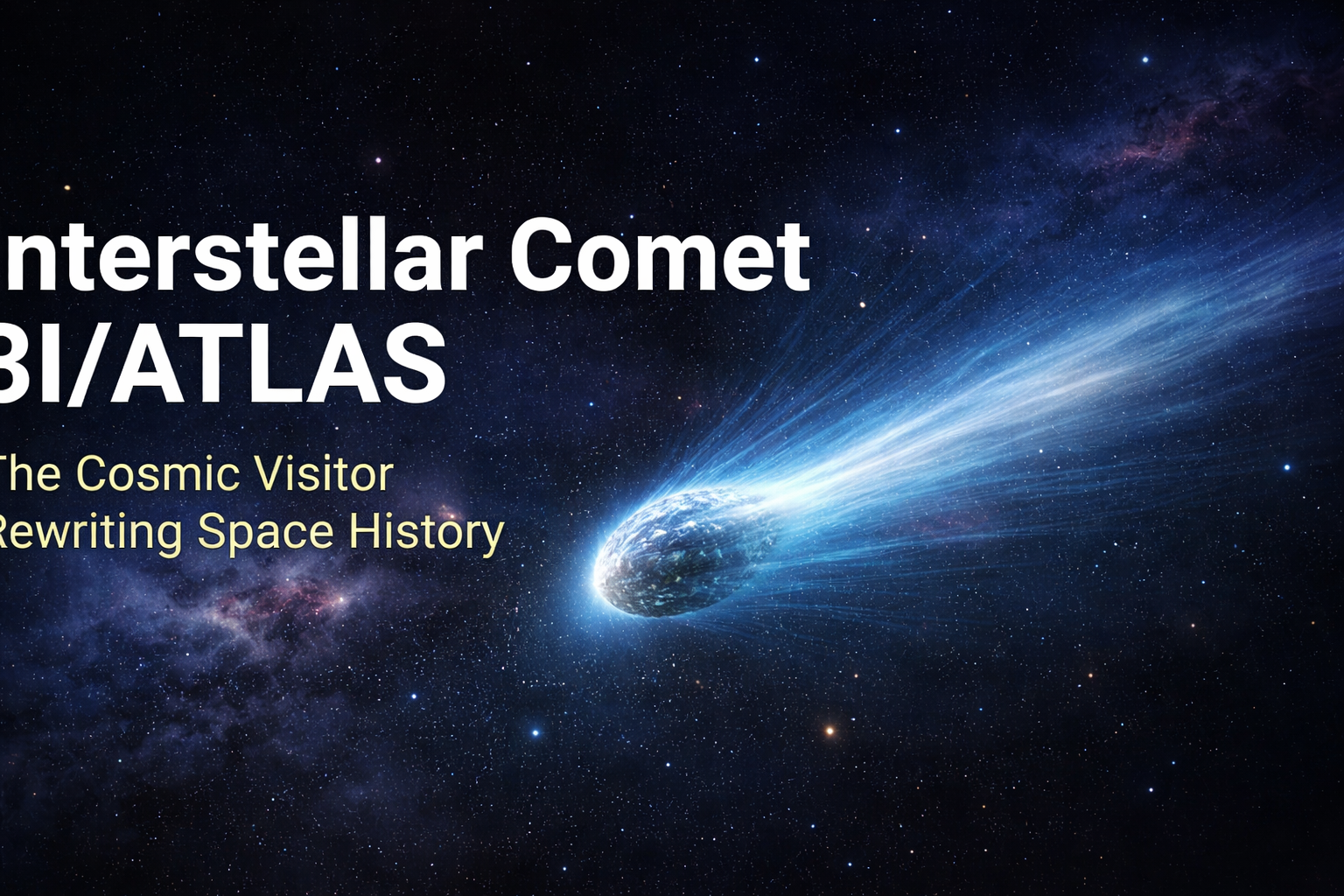
Interstellar Comet 3I/ATLAS: The Cosmic Visitor Rewriting Space History
Picture yourself standing beneath a star-filled sky, watching a visitor that has traveled thousands of light-years across the Milky Way galaxy—a cosmic wanderer carrying secrets from an alien solar system. This isn’t science fiction. Throughout 2025, astronomers have been racing against time to study interstellar comet 3I/ATLAS before it vanishes forever into the darkness between stars.
Discovered in July 2025 by the ATLAS survey telescope, this extraordinary object marks only the third confirmed interstellar visitor detected passing through our solar system. Unlike comets born orbiting our Sun, 3I/ATLAS originated from another star system entirely, offering scientists an unprecedented opportunity to examine material forged under completely different cosmic conditions.
What makes this visitor particularly fascinating isn’t just its exotic origin—it’s the string of unexpected behaviors that have kept astronomers worldwide glued to their telescopes. From bizarre wobbling jets that defy typical cometary physics to chemical signatures unlike anything seen before, 3I/ATLAS has challenged our understanding of how comets behave and what they can tell us about planetary systems across the galaxy.
The Dramatic Discovery: Finding a Needle in the Cosmic Haystack
How ATLAS Caught the Interstellar Intruder
On July 1, 2025, the NASA-funded ATLAS survey telescope at Río Hurtado, Chile, detected an extremely faint object moving through space at approximately 61 kilometers per second—roughly 136,000 miles per hour relative to the Sun. At magnitude 18 brightness, the object was invisible to human eyes and required sophisticated automated detection systems to identify it among millions of background stars.
The discovery location proved crucial to understanding why 3I/ATLAS wasn’t spotted sooner. Archival searches revealed the comet had been passing directly in front of the Galactic Center’s dense star fields throughout June 2025, effectively hiding in plain sight among countless background stars. Only when it emerged from this crowded region did automated detection algorithms flag its unusual motion.
Within hours of the initial detection, professional and amateur astronomers worldwide scrambled to observe the mysterious object. Follow-up observations on July 2 revealed the telltale signs of cometary activity—a diffuse coma surrounding a central nucleus and potential tail elongation. By that evening, the Minor Planet Center officially designated it as 3I/ATLAS, marking it as the third confirmed interstellar object after the enigmatic ‘Oumuamua and the more conventional 2I/Borisov.
Pre-Discovery Observations Reconstruct Hidden Journey
Diligent archival searches extended the observational record backward in time. Astronomers discovered images of 3I/ATLAS in data from the Zwicky Transient Facility dating back to June 14, 2025, and even found a May 21 observation from Israel’s Weizmann Astrophysical Observatory. These pre-discovery detections allowed precise calculation of the comet’s trajectory and confirmed its extrasolar origin beyond any doubt.
The hyperbolic trajectory—with an orbital eccentricity exceeding 1.0—mathematically proves the comet originated from outside our solar system and is merely passing through on a one-way journey. When traced backward, 3I/ATLAS’s path clearly originates from interstellar space, potentially carrying material formed billions of years ago around a star we may never identify.
Physical Characteristics: A Comet Unlike Any Other
The Elusive Nucleus and Rotation Mystery
Determining the actual size of 3I/ATLAS’s solid nucleus presents extraordinary challenges. The active coma of gas and dust surrounding the nucleus makes it appear much brighter and larger than reality. Hubble Space Telescope observations from August 2025 placed the upper limit on nucleus diameter at 3.5 miles, though it could be as small as 1,444 feet across.
The most reliable estimates come from analyzing non-gravitational forces—the rocket-like thrust produced by outgassing vapors. If this acceleration is purely caused by outgassing, it suggests the nucleus has a mass of roughly 4.4×10^10 kilograms, corresponding to a diameter between 0.32 and 0.46 miles assuming typical comet densities. This makes 3I/ATLAS substantially larger than 2I/Borisov but orders of magnitude less massive than initially feared.
Rotation period measurements revealed another peculiarity. Multiple observing campaigns determined a rotation period of approximately 16.16 hours based on brightness variations, yet wobbling jet structures observed in August 2025 suggested a precession period of 7.74 hours, implying the nucleus rotates every 15.5 hours if a single active jet source dominates.
The Extraordinary Chemical Composition
James Webb Space Telescope observations in August 2025 revealed the most detailed chemical analysis of an interstellar comet ever obtained. Near-infrared spectroscopy showed 3I/ATLAS’s coma is unusually rich in carbon dioxide gas, with smaller amounts of water ice, water vapor, carbon monoxide, and carbonyl sulfide. This carbon dioxide dominance—with CO₂/H₂O ratios around 8:1—dramatically differs from typical solar system comets where water usually dominates.
This chemistry tells a fascinating story about formation conditions. High carbon dioxide concentrations suggest 3I/ATLAS formed in the extremely cold outer regions of its birth planetary system, far from its parent star where temperatures allowed CO₂ to freeze but were too warm for certain other volatiles. The composition essentially freezes a snapshot of chemical conditions in an alien solar system billions of years ago.
Observations by the Very Large Telescope showed 3I/ATLAS emitting cyanide gas and atomic nickel vapor at concentrations similar to those seen in solar system comets. The nickel detection particularly intrigued researchers, as it appears in emission lines without corresponding iron—an unusual but not unprecedented pattern that sparked considerable scientific debate about its implications.
The Bizarre Wobbling Jets and Sun-Facing Tail
Perhaps the most unexpected discovery came from detailed monitoring of 3I/ATLAS’s dust and gas emissions. Observations across 37 nights between July and September 2025 using the Two-meter Twin Telescope at Teide Observatory revealed jet structures within a sun-facing “anti-tail” that appeared to wobble with a period of approximately 7.74 hours.
Most comets develop tails pointing away from the Sun, pushed by solar radiation pressure and the solar wind. Anti-tails—apparent tails pointing toward the Sun—are rare optical phenomena usually explained by viewing geometry. However, 3I/ATLAS displayed jet structure extending up to 620,000 miles that genuinely pointed sunward rather than being a geometric illusion, making it exceptionally unusual.
The wobbling motion of these jets indicates they originate from active regions near the rotation poles of the nucleus, with the jet base offset by less than 8 degrees from the rotation axis. As the nucleus spins, the jets precess like a wobbling top, creating the observed periodic variations. This marks the first time such periodic jet modulation has been detected in an interstellar comet, providing unique insights into how pristine bodies from other planetary systems respond to solar heating.
Extreme Negative Polarization: A Puzzling Signature
Polarimetric observations by multiple telescopes revealed that 3I/ATLAS’s coma exhibits an unusually high degree of negative polarization at small phase angles, with parameters significantly different from all known comets. When light scatters off the coma particles, its polarization characteristics reveal information about particle size, shape, and composition.
The extreme negative polarization of 3I/ATLAS resembles that seen in trans-Neptunian objects and Centaurs rather than typical comets, suggesting the coma contains a distinctive mixture of icy and dark material. This unique scattering behavior may indicate that interstellar radiation during its journey through space altered the surface properties of dust grains in ways not experienced by solar system comets.
The Multi-Mission Observational Campaign
Unprecedented Coordination Across Space and Time
NASA assets gathering observations included Hubble, Webb, TESS, Swift, SPHEREx, Perseverance Mars rover, Mars Reconnaissance Orbiter, MAVEN, Europa Clipper, Lucy, Psyche, Parker Solar Probe, PUNCH, and ESA/NASA’s SOHO—representing the most comprehensive study of an interstellar object ever conducted.
Parker Solar Probe observed 3I/ATLAS from October 18 to November 5, 2025, capturing around 10 images per day with its WISPR instrument during a critical period when the comet passed too close to the Sun for Earth-based telescopes to observe safely. These observations filled a crucial observational gap that would otherwise have left scientists blind to the comet’s behavior during its most active phase.
Mars-based assets provided extraordinary perspectives impossible from Earth. During the comet’s October 3 close approach to Mars at just 0.19 astronomical units, the Perseverance rover, Mars Reconnaissance Orbiter, and MAVEN all captured images, offering triangulation data that significantly refined trajectory calculations.
X-Ray Observations Reveal Solar Wind Interactions
ESA’s XMM-Newton spacecraft observed 3I/ATLAS with its European Photon Imaging Camera, detecting X-ray emissions from the interaction between the comet’s coma and the solar wind. These X-ray observations extended roughly 250,000 miles into space, revealing how solar wind ions collide with neutral gas molecules in the coma, stripping electrons and producing characteristic X-ray fluorescence.
This X-ray glow provides information about the density and composition of the coma that’s difficult to obtain through optical observations alone. The fact that interstellar comets produce similar X-ray signatures to solar system comets suggests fundamental cometary physics operates consistently regardless of which star system formed the comet.
Gemini Observatory Captures Post-Perihelion Evolution
On November 26, 2025, scientists used the Gemini Multi-Object Spectrograph on Gemini North at Maunakea to obtain images revealing how the comet changed after its closest approach to the Sun. These post-perihelion observations as part of the “Shadow the Scientists” public outreach initiative showed the comet’s coma maintaining an unusual greenish glow from diatomic carbon emissions.
The continued monitoring documented how 3I/ATLAS’s gas composition and outburst behavior evolved as it cooled while moving away from the Sun. Such long-term tracking of compositional changes helps scientists understand volatile distribution within the nucleus and how different ices sublime at various temperatures.
The Scientific Gold Mine: What 3I/ATLAS Teaches Us
A Chemical Time Capsule from an Alien World
Every measurement of 3I/ATLAS provides clues about conditions in the distant planetary system where it formed. The high carbon dioxide and carbon monoxide content suggests formation in an extremely cold environment—likely beyond the “snow line” where these gases freeze into ice. The relative depletion of water compared to CO₂ indicates the comet may have formed farther from its parent star than Jupiter’s distance from our Sun.
The presence of complex organic compounds—evidenced by the reddish coma coloration from tholins—demonstrates that prebiotic chemistry occurs in planetary systems throughout the galaxy. These irradiated organic molecules form when ultraviolet radiation and cosmic rays bombard simpler compounds over millions of years, potentially creating building blocks relevant to the emergence of life.
Age estimates based on the comet’s likely origin from the Milky Way’s thick disk suggest 3I/ATLAS could be at least 7 billion years old—substantially older than our 4.6-billion-year-old solar system. If true, this visitor carries material predating Earth itself, offering a glimpse into the chemical environment of the early galaxy when star and planet formation proceeded under different conditions.
Testing Planetary Defense and Detection Systems
While 3I/ATLAS posed zero threat to Earth, its passage provided invaluable practice for planetary defense networks. ESA refined trajectory predictions by combining Earth-based observations with data from the ExoMars Trace Gas Orbiter at Mars, improving accuracy by a factor of ten through triangulation techniques.
This multi-platform approach demonstrated how spacecraft throughout the solar system can contribute to tracking potentially hazardous objects. The detection, characterization, and tracking methodologies refined during the 3I/ATLAS campaign directly strengthen humanity’s ability to identify and monitor genuine threats in the future.
The Techno signature Search: Finding No Artificial Signals
The Breakthrough Listen Initiative conducted observations of 3I/ATLAS using facilities worldwide, including the Allen Telescope Array, Murr yang Parkes Radio Telescope, Meerkat, and the 100-meter Green Bank Telescope. These searches spanned frequencies from 700 MHz to 12 GHz, looking for any artificial radio emissions that might suggest technological origin.
On December 18, 2025, less than 24 hours before closest approach to Earth, observations with the Green Bank Telescope achieved sensitivity to transmitters with effective power of approximately 0.1 watts—more sensitive than a mobile phone. No artificial radio signals localized to 3I/ATLAS were detected at any frequency, consistent with natural astrophysical processes.
These null results don’t diminish 3I/ATLAS’s scientific value—they confirm it as an authentic natural comet while establishing protocols for thoroughly investigating future interstellar visitors. The rigorous techno signature searches demonstrate the scientific community’s commitment to exploring all possibilities when examining objects from beyond our solar system.
The Controversy: Natural Wonder or Something More?
Avi Loeb’s “Anomalies” and Scientific Pushback
Harvard astrophysicist Avi Loeb, known for proposing that ‘Oumuamua might have artificial origins, has argued that 3I/ATLAS exhibits numerous anomalies that challenge natural explanations. His list includes the comet’s retrograde trajectory alignment with the ecliptic plane, the persistent sun-facing jets, unusual nickel-to-iron ratios, extreme negative polarization, and rapid brightening behavior.
Loeb suggests the nickel-heavy spectroscopic signature resembles industrial alloys, arguing the nickel/iron imbalance could indicate manufacturing rather than natural processes. He has calculated statistical probabilities for various characteristics, concluding the combination of features makes a natural origin implausible.
However, critics including Jason Wright and Darryl Seligman counter that post-hoc probabilities inflate apparent rarity, ecliptic alignment is natural for some interstellar objects, sunward jets can be explained by gas drag and radiation pressure effects seen in other comets, and nickel ratios fall within known cometary variation.
NASA has explicitly stated that while the agency actively searches for signs of life, 3I/ATLAS is of natural origin. The scientific consensus views it as an unusual but natural comet whose distinctive characteristics reflect its exotic formation environment and interstellar journey rather than artificial construction.
The Value of Extraordinary Claims
Despite the controversy, Loeb’s attention to 3I/ATLAS’s unusual features has driven more thorough investigation than might otherwise have occurred. The debate has fostered productive interdisciplinary dialogue spanning astrobiology, planetary defense, and techno signature detection methodology.
The lesson here isn’t that every interstellar object deserves speculation about artificial origins. Rather, it’s that maintaining scientific rigor requires considering all hypotheses—even unconventional ones—while demanding proportionate evidence. The overwhelming evidence supports 3I/ATLAS as a pristine natural comet from another stellar system, making it scientifically valuable precisely because it’s natural, not despite it.
Journey Through the Solar System: The Complete Trajectory
Inbound: Racing Toward the Inner Solar System
When discovered in July 2025, 3I/ATLAS was located 4.51 astronomical units from the Sun—beyond Mars’s orbit—and approaching at tremendous speed. Its hyperbolic trajectory carried it inward through the asteroid belt and into the planetary zone where Earth, Venus, and Mercury orbit.
Throughout August and September, the comet’s activity increased dramatically as solar heating intensified. The coma expanded from roughly 16,000 miles in diameter to over 700,000 miles across, while gas production rates accelerated. Carbon dioxide sublimation began driving significant outgassing, creating the distinctive jets and anti-tail features that would define 3I/ATLAS’s personality.
Perihelion and Solar Conjunction
3I/ATLAS reached perihelion—its closest point to the Sun—on October 30, 2025, at a distance of approximately 1.4 astronomical units, just inside Mars’s orbit. At this distance, the comet never approached close enough to the Sun for extreme heating that fragments some comets but received sufficient solar energy to drive vigorous outgassing.
From Earth’s perspective, the comet passed behind the Sun in October, creating a several-week period when ground-based observations were impossible due to the comet’s apparent proximity to the solar disk. This solar conjunction period highlighted the value of space-based assets like Parker Solar Probe that could continue monitoring from different vantage points.
Closest Approach to Earth and the Final Observations
On December 19, 2025, 3I/ATLAS made its closest approach to Earth at approximately 1.8 astronomical units—about 170 million miles away, never posing any danger to our planet. At this distance, the comet appeared as a faint fuzzy patch visible only through moderate to large telescopes under dark skies.
Recent observations show the comet maintaining its unusual characteristics even as it cools and recedes. Ground-based imaging from late December 2025 revealed the comet still displaying a tight central condensation with an asymmetric, lopsided coma rather than relaxing into the more diffuse, symmetric appearance typical of most comets after perihelion.
Outbound: The Long Goodbye
3I/ATLAS now races outward on its hyperbolic trajectory, gradually fading as it moves farther from both the Sun and Earth. By March 2026, it will pass within 2 astronomical units of Jupiter, though not close enough for significant gravitational interaction. Astronomers plan to monitor whether this distant encounter produces any observable changes in the comet’s activity or coma morphology.
Within a year or two, 3I/ATLAS will fade beyond the detection limits of even the largest telescopes, disappearing back into the interstellar darkness from which it came. Unlike solar system comets that return on predictable schedules, this visitor will never be seen again continuing its journey across the Milky Way for millions of years until perhaps encountering another star system entirely.
How to Observe 3I/ATLAS (While You Still Can)
Current Visibility and Equipment Requirements
As of late December 2025, 3I/ATLAS has faded to approximately 13th magnitude, requiring a telescope with at least 8-10 inches of aperture under dark skies. Light pollution significantly hampers observation, making rural locations far from city lights essential for visual detection.
The comet currently resides in the constellation Leo, moving slowly eastward against the background stars. Precise coordinates change daily, so observers should consult updated ephemerides from sources like the Minor Planet Center or TheSkyLive before attempting observations.
Astrophotography Techniques
Successfully imaging 3I/ATLAS requires long exposure times and careful technique. Most astrophotographers use exposures of 2-5 minutes and stack multiple images to accumulate faint light while reducing noise. The comet’s motion relative to background stars necessitates tracking the comet’s position during stacking rather than the stars.
Advanced processing techniques can reveal subtle features invisible to direct observation, including tail extensions and coma asymmetries. Using narrowband filters tuned to specific emission lines like CN (cyanogen) or C₂ (diatomic carbon) can isolate particular chemical species and create striking false-color images.
The Deadline: Observing an Evaporating Opportunity
Every week that passes, 3I/ATLAS fades further as it moves away from the Sun and Earth. By early 2026, the comet will have dimmed beyond the reach of most amateur equipment, remaining detectable only through professional observatory telescopes. By mid-2026, even those observations will become prohibitively difficult.
This creates genuine urgency for anyone hoping to glimpse this interstellar visitor firsthand. Unlike Halley’s Comet or other periodic comets that return on predictable schedules, 3I/ATLAS offers a once-in-civilization opportunity. Once it fades from view, no human will ever see it again.
The Future of Interstellar Object Detection
How Common Are These Cosmic Wanderers?
The discovery of three confirmed interstellar objects within eight years suggests these visitors pass through the inner solar system more frequently than previously imagined. Statistical models now estimate dozens of interstellar objects might traverse the region inside Jupiter’s orbit annually, though most remain undetected due to their faintness or unfortunate timing.
The detection rate depends critically on survey capabilities. ATLAS scans large portions of sky relatively frequently but reaches only moderate depth. Upcoming facilities like the fully operational Vera C. Rubin Observatory will monitor the entire visible sky every few nights with unprecedented sensitivity, potentially discovering interstellar objects monthly rather than every few years.
Missions to Intercept Future Visitors
ESA’s Comet Interceptor mission, planned for launch in the late 2020s, represents humanity’s first attempt to rendezvous with a pristine long-period comet or interstellar object. The spacecraft will park at the Sun-Earth Lagrange Point 2, waiting for astronomers to discover a suitable target, then race to intercept it while still inbound toward the Sun.
Such missions could revolutionize our understanding of interstellar objects by obtaining direct samples and ultra-close-range observations impossible through remote sensing. Analyzing material directly from an interstellar comet’s nucleus would provide definitive answers about composition, isotopic ratios, and organic chemistry that can only be inferred from spectroscopy.
NASA and other space agencies are developing concepts for rapid-response missions capable of launching quickly after discovering a new interstellar visitor. The key challenge involves building spacecraft that can sit in storage for years, then launch and accelerate fast enough to catch an object moving at 30-60 kilometers per second through the solar system.
Frequently Asked Questions
Q: What is interstellar comet 3I/ATLAS and where did it come from?
A: 3I/ATLAS is a comet that originated from another star system in the Milky Way galaxy and is passing through our solar system on a hyperbolic trajectory that will carry it back into interstellar space. Its orbital path and high velocity definitively prove it wasn’t born orbiting our Sun. While scientists know it came from interstellar space, determining which specific star system ejected it billions of years ago remains extremely difficult because stellar motions and gravitational interactions scramble trajectories over such vast timescales.
Q: Is 3I/ATLAS dangerous to Earth or other planets?
A: No, 3I/ATLAS poses absolutely no threat to Earth or any other planet. Its trajectory was precisely calculated from hundreds of observations, and its closest approach to Earth occurred on December 19, 2025, at a safe distance of approximately 170 million miles—nearly twice the distance between Earth and the Sun. The comet is now moving away from our planet and will never return.
Q: How fast is interstellar comet 3I/ATLAS traveling?
A: When discovered, 3I/ATLAS was moving at approximately 61 kilometers per second (136,000 miles per hour) relative to the Sun. As it approached the Sun, gravitational acceleration increased its speed to about 68 kilometers per second at perihelion. As it exits the solar system, it will decelerate back to its original entry velocity and maintain that speed as it ventures back into the vast emptiness between stars.
Q: What makes a comet “interstellar” compared to a regular comet?
A: An interstellar comet has a hyperbolic orbit with orbital eccentricity greater than 1.0, meaning it has enough velocity to escape the Sun’s gravity and originated from outside our solar system. Regular comets are gravitationally bound to the Sun and follow elliptical orbits that bring them back repeatedly, sometimes on schedules of decades, centuries, or millennia. The mathematical difference lies in orbital energy—interstellar objects possess excess velocity acquired from their formation system or from gravitational slingshots around other stars.
Q: Why is 3I/ATLAS’s composition so different from regular comets?
A: 3I/ATLAS formed in a completely different star system under potentially very different conditions than solar system comets. Its unusually high carbon dioxide and carbon monoxide content compared to water suggests it formed in the extremely cold outer regions of its birth planetary system, far from the parent star. Additionally, its journey through interstellar space for potentially billions of years exposed it to cosmic radiation and ultraviolet light that may have altered its surface chemistry in ways solar system comets never experience.
Q: Can I still see 3I/ATLAS with my own telescope?
A: As of late December 2025, 3I/ATLAS has faded to approximately 13th magnitude and requires at least an 8–10-inch telescope under very dark skies to observe visually. The comet appears as an extremely faint fuzzy patch in the constellation Leo and continues fading as it moves farther from the Sun and Earth. Within weeks to months, it will dim beyond the reach of most amateur equipment. Astrophotographers using longer exposures and image stacking can still capture it, but the window of opportunity is rapidly closing.
Conclusion: The Messenger From Beyond
Interstellar comet 3I/ATLAS represents far more than an astronomical curiosity—it’s a messenger carrying information from another corner of our galaxy, offering insights impossible to obtain any other way. Every spectrum, every image, every measurement contributes to understanding how planetary systems form and evolve around stars vastly different from our Sun.
The collaborative response to 3I/ATLAS showcases the extraordinary capabilities of modern astronomy and international scientific cooperation. Dozens of telescopes on Earth and throughout the solar system coordinated observations, professional and amateur astronomers contributed data, and researchers across multiple disciplines worked together to extract maximum knowledge from this fleeting opportunity.
As 3I/ATLAS fades into the cosmic darkness, it leaves behind a treasure trove of data that scientists will analyze for years. The lessons learned—about detection strategies, rapid response protocols, multi-platform coordination, and interstellar object characterization—prepare humanity for future visitors and perhaps eventually for missions that chase these cosmic wanderers directly.
The universe has delivered an extraordinary gift in 3I/ATLAS. This visitor from another star system has expanded our understanding of cometary diversity, tested our technological capabilities, and reminded us that we live in a dynamic galaxy where material regularly travels between stellar systems. Each interstellar object detected brings us closer to understanding the true nature of the cosmic neighborhood we inhabit.
What other wonders await discovery in the years ahead? With next-generation survey telescopes coming online and space missions poised to intercept these visitors directly, humanity stands at the threshold of a golden age for interstellar object studies. The third visitor has come and will soon depart, but it won’t be the last—and each new discovery promises to rewrite our cosmic story once again.
Share this article with fellow space enthusiasts and keep watching the skies—the fourth interstellar visitor could be discovered at any moment, carrying new mysteries from the vast spaces between the stars!


You have brought up a very wonderful points, appreciate it for the post.
Nicely put, Regards.