

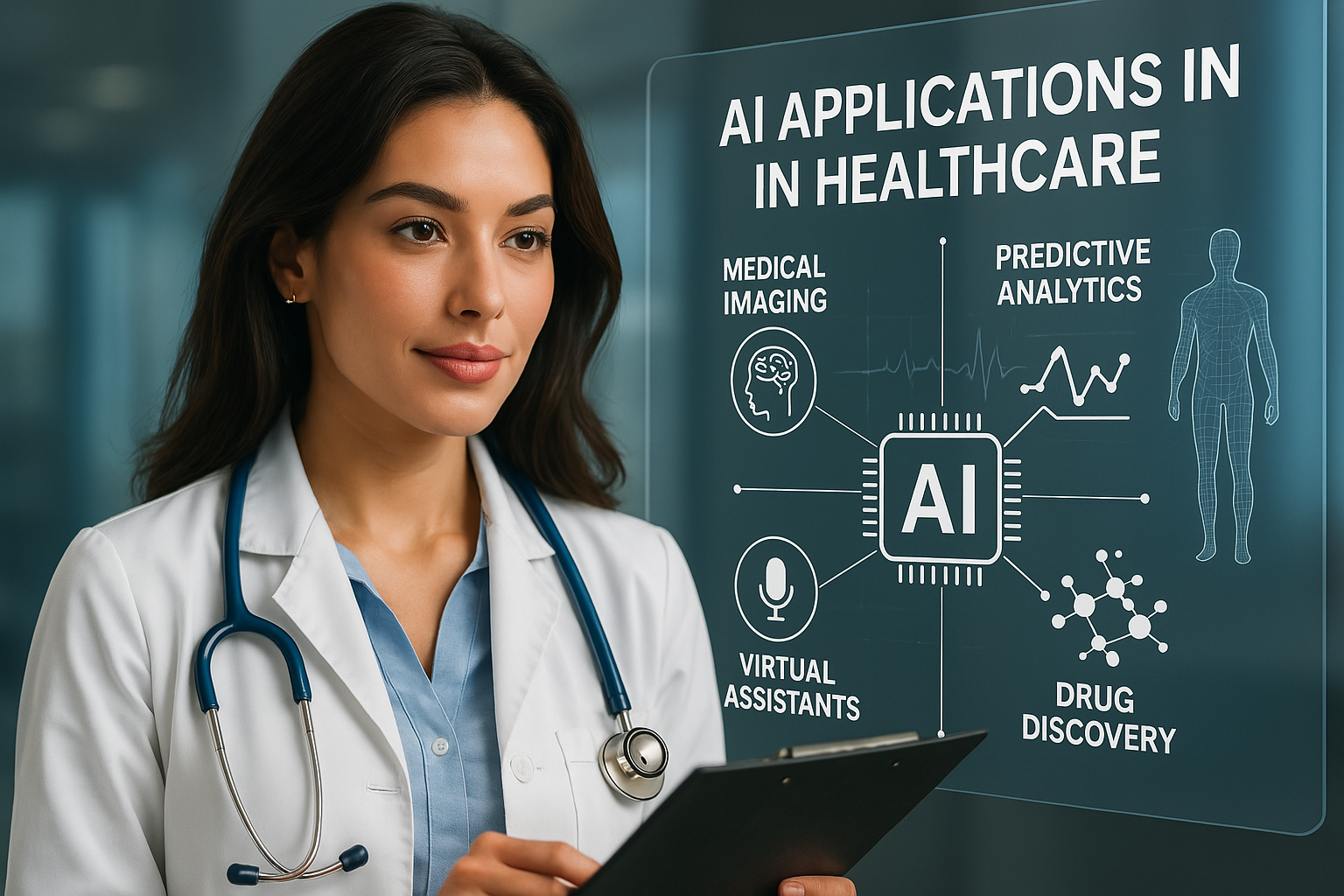
AI Applications in Healthcare: How Artificial Intelligence is Transforming Medical Systems in 2025
Introduction:
Artificial Intelligence isn’t just “supporting” healthcare anymore — it’s straight-up reshaping it. From diagnosing diseases faster than human specialists to automating hospital workflows, AI in healthcare has become the backbone of modern medical systems in 2025.
Hospitals, clinics, and even small healthcare centers now rely on AI-powered tools to improve accuracy, reduce costs, and speed up life-saving decisions. And honestly? The pace is wild. The healthcare industry is entering its most disruptive decade ever.
In this in-depth guide, let’s break down how AI applications in healthcare are transforming global medical systems in 2025, what solutions are truly working, and how this shift will redefine medical care over the next few years.
Why AI in Healthcare Is Exploding in 2025
AI adoption in healthcare didn’t happen overnight. The jump in 2025 is driven by a perfect mix of tech maturity, need, and innovation.
Key Factors Behind the Rapid Growth
-
Massive clinical data availability (EHRs, imaging, wearables)
-
Cheaper computing power & faster AI models
-
Shortage of healthcare workers
-
Demand for cheaper, faster, more accurate care
-
Government support for digital health transformation
A 2024 WHO analysis noted that AI-assisted diagnostics reduced error rates by up to 40%, especially in radiology and oncology. By 2025, this has become standard practice in hospitals across the US, UK, India, UAE, and Singapore.
Top AI Applications in Healthcare in 2025
This is where things get exciting. Here are the most game-changing real-world applications of artificial intelligence in medical systems today.
1. AI in Medical Imaging & Diagnostics
Medical imaging is one of the earliest and strongest use cases of AI — and in 2025, it’s borderline magical.
AI Outperforms Human Specialists
Modern AI tools analyze:
-
X-rays
-
MRIs
-
CT scans
-
Mammograms
-
Ultrasounds
They detect abnormalities with unmatched precision.
For example, new FDA-approved AI models detect breast cancer up to 6 years earlier than conventional methods. That’s life changing.
Benefits
-
Faster diagnosis (seconds instead of hours)
-
Higher accuracy
-
Reduced workload on radiologists
-
Better early-stage detection
Real Example
AI-based tools from companies like Google Health, DeepMind, IBM Watson Health (newly restructured), and Siemens Healthiness are widely used in hospitals in 2025.
2. AI-Powered Predictive Analytics & Risk Forecasting
Predictive analytics might be the most underrated AI application — but it’s saving the most lives.
How It Works
AI uses health records + lifestyle data + labs + imaging to forecast:
-
Heart attack risk
-
Stroke probability
-
Diabetes progression
-
Cancer recurrence
-
Hospital readmission risk
Instead of reacting to diseases, doctors can now prevent them.
A Game-Changing Example
AI models in 2025 can predict heart failure 3–5 years before symptoms appear using subtle ECG and blood markers.
3. AI in Drug Discovery & Personalized Medicine
Old drug development takes 8–12 years. AI in 2025?
It cuts that time by 50–70%.
What AI Can Do Now
-
Simulate how drugs will behave
-
Identify molecular targets
-
Design new compounds
-
Predict side effects
-
Personalize treatment based on patient DNA
This isn’t sci-fi — it’s happening right now with companies like NVIDIA BioNeMo, Moderna, and Deep Genomics.
Personalized Treatments
AI tailors treatments based on:
-
Genetics
-
Environment
-
Medical history
-
Response patterns
This eliminates one-size-fits-all medicine.
4. Robotics + AI in Hospitals (Automation on Steroids)
2025 hospitals are full of quiet AI-powered robots that handle:
-
Surgery assistance
-
Medicine delivery
-
Sanitization
-
Patient movement
-
Inventory management
Robotic Surgery
AI-assisted robots improve:
-
Precision
-
Stability
-
Outcomes
-
Speed
By 2025, robot-assisted surgeries are up by 30% globally.
5. AI in Telemedicine & Virtual Health Assistants
Telemedicine went mainstream post-COVID, but AI elevated it.
What AI Virtual Assistants Can Do
-
Analyze symptoms
-
Schedule appointments
-
Check medicine interactions
-
Provide mental health support
-
Monitor chronic diseases
This is huge in countries like India and Pakistan where access to specialists is limited.
6. AI in Hospital Management & Workflow Optimization
Hospitals lose millions every year due to inefficiency.
AI fixes this problem.
Uses
-
Staff scheduling
-
Resource allocation
-
Queue management
-
Bed availability prediction
-
Emergency response routing
AI reduces hospital wait times by 25–40% in 2025.
7. AI for Mental Health Support
Mental health tech exploded in 2024–2025.
AI can detect:
-
Anxiety patterns
-
Depression indicators
-
Sleep disorders
-
Emotional tone
It gives early alerts before things get worse.
8. How AI Strengthens Public Health Systems & Pandemic Preparedness
AI isn’t just transforming hospitals — it’s upgrading entire public health infrastructures worldwide. In 2025, governments and health agencies use AI to track emerging infections, predict outbreak patterns, and analyze real-time data from hospitals, airports, and wearable devices. This allows health departments to spot unusual spikes before they turn into crises. AI models can now forecast disease spread weeks in advance, helping authorities prepare medical supplies, reinforce hospital capacity, and activate emergency response teams faster than ever. This shift in public health strategy makes communities safer, reduces national healthcare costs, and prevents the huge losses seen during previous outbreaks.
Benefits of AI in Healthcare (Why It Matters)
Let’s break it down simply.
Key Advantages
-
Earlier diagnosis
-
Lower costs
-
Faster treatment
-
Personalized care
-
Reduced doctor burnout
-
Enhanced access in rural areas
AI isn’t replacing doctors — it’s upgrading them.
Challenges & Ethical Concerns
AI is powerful, but not perfect.
Main Issues
-
Data privacy
-
Algorithm bias
-
Overreliance on machines
-
High implementation cost
-
Need for regulation
Governments and hospitals must address these issues before relying on AI completely.
Conclusion
AI applications in healthcare are transforming medical systems in 2025 in ways we couldn’t imagine a decade ago. From early disease detection to predictive analytics and robotics, AI is pushing healthcare into a smarter, faster, and more patient-centric era.
The future?
AI won’t replace doctors — but doctors using AI will absolutely outperform those who don’t.
❓ FAQ Section
Q1. What are the top AI applications in healthcare in 2025?
AI is most commonly used in diagnostics, imaging, robotic surgery, predictive analytics, hospital automation, and drug discovery.
Q2. How is AI improving diagnosis accuracy?
AI analyzes medical images, lab results, and biomarkers faster and more accurately, reducing human error and detecting diseases earlier.
Q3. Can AI replace doctors in the future?
No — AI supports doctors by automating tasks and improving decision-making, but human judgment remains essential.
Q4. Is AI safe to use in hospitals?
Yes, if properly regulated. Most AI systems used in 2025 are FDA or government approved and continuously monitored.
Q5. How does AI help patients at home?
Virtual assistants, telemedicine bots, and wearable devices track symptoms, provide reminders, and alert doctors if something seems off.


