

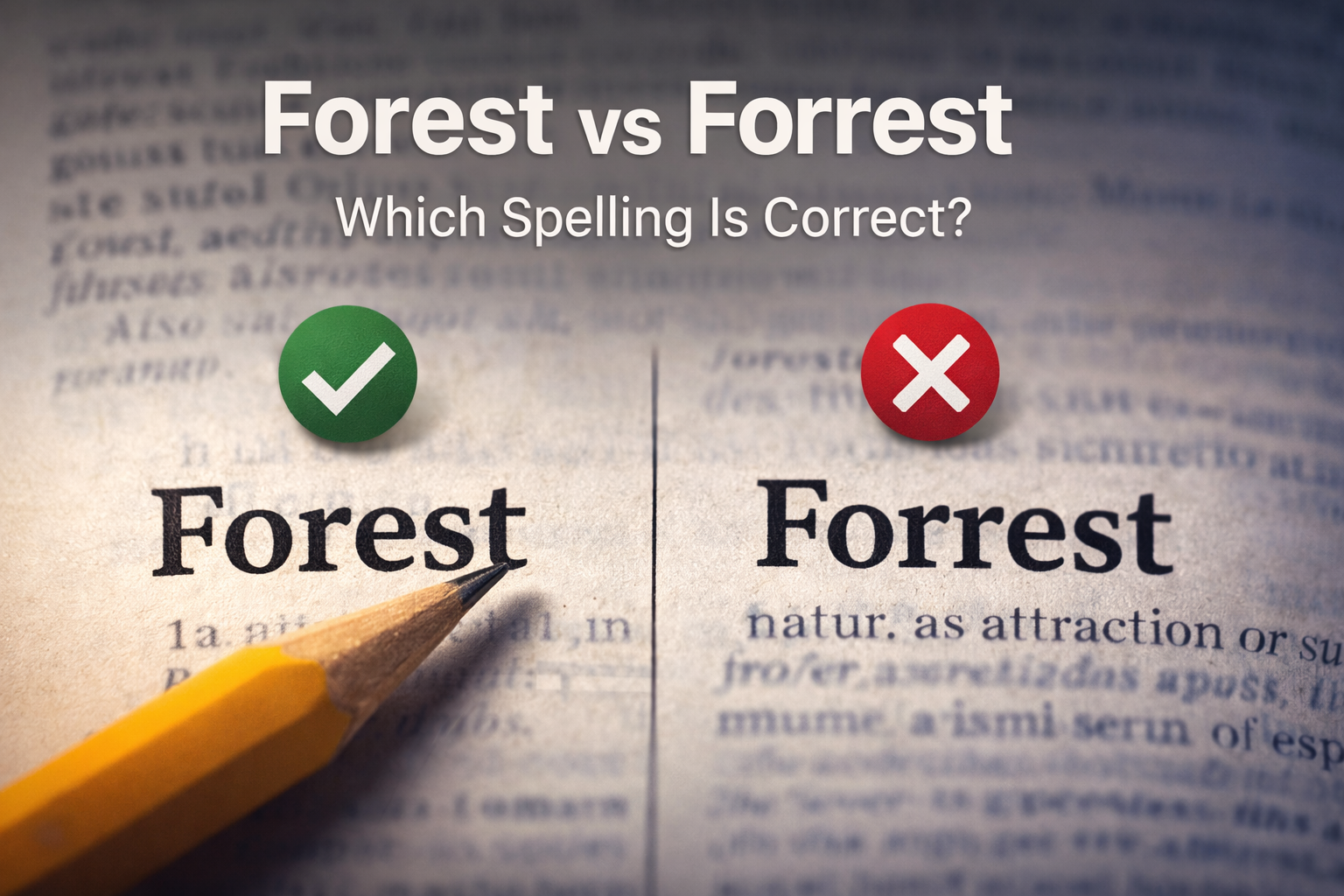
Forest vs Forrest: Which Spelling Is Correct? (Don’t Make This Mistake!)
Introduction:
Picture this: You’re writing an important email about environmental conservation, and you type “The Amazon forrest is disappearing.” You hit send, feeling confident—until a colleague points out your spelling error. Embarrassing, right?
You’re not alone. Over 27,000 people search “forest vs forrest” every month, desperately seeking clarity on which spelling is correct. This seemingly simple confusion has tripped up students, professionals, and even experienced writers.
Here’s the definitive answer: “Forest” is the correct spelling when referring to a large wooded area. “Forrest” is not a standard English word—it exists only as a proper noun, typically used as a name.
This comprehensive guide will eliminate your confusion forever. We’ll explore definitions, usage examples, linguistic origins, and provide memory techniques that make the correct spelling automatic. You’ll also discover how this simple distinction connects to broader patterns in English spelling and grammar.
Just as November’s Supermoon Will Light Up the Sky Like Never Before illuminates the night, we’ll shed light on this confusing spelling pair.
What Does “Forest” Mean? The Complete Definition
Dictionary Definition and Core Meaning
According to the Merriam-Webster Dictionary and Oxford Dictionary, “forest” (noun) refers to:
- A large tract of land covered with trees and undergrowth
- A dense growth of trees and plants covering an extensive area
- A complex ecosystem supporting diverse wildlife and vegetation
- Something resembling a forest in density or profusion (metaphorical use)
Authoritative pronunciation: /ˈfɒr.ɪst/ (FOR-ist) in British English; /ˈfɔːr.ɪst/ (FOR-ist) in American English.
Real-World Usage Examples
Environmental context:
- The Amazon forest produces approximately 20% of the world’s oxygen supply.
- Deforestation has destroyed over 178 million hectares of forest since 1990, according to the World Wildlife Fund.
Everyday conversation:
- “We spent the weekend hiking through a magnificent forest in the Appalachian Mountains.”
- “Children’s imaginations run wild with stories about enchanted forests.”
Idiomatic expressions:
- “Can’t see the forest for the trees” – being too focused on details to see the bigger picture
- “A forest of hands” – many raised hands (metaphorical usage)
Scientific Classification of Forests
Understanding forest types strengthens your grasp of proper terminology:
By latitude and climate:
- Tropical rainforests – High biodiversity, year-round rainfall (Amazon, Congo Basin)
- Temperate forests – Four distinct seasons, deciduous or mixed trees (European forests)
- Boreal forests (Taiga) – Cold-climate coniferous trees (Canada, Scandinavia, Russia)
- Mediterranean forests – Dry summers, mild winters (California chaparral)
By ecosystem:
- Primary forests – Old-growth, never logged (less than 36% remain globally)
- Secondary forests – Regenerated after disturbance
- Plantation forests – Artificially planted for timber or conservation
This vocabulary appears across environmental science, geography, biology, ecology, and climate studies—making correct spelling essential for academic and professional credibility.
What Does “Forrest” Mean? Separating Fact from Fiction
The Truth About “Forrest” in English Dictionaries
Here’s what most people don’t know: “Forrest” does not appear in major English dictionaries as a common noun. It has zero linguistic validity as a word meaning “woodland area.”
The Oxford English Dictionary, Merriam-Webster, Cambridge Dictionary, and Collins Dictionary all confirm: “Forrest” exists exclusively as:
- A surname (family name of English or Scottish origin)
- A given name (first name, particularly in the United States)
- A geographical designation (specific place names with historical spelling)
Historical Etymology of the Name “Forrest”
The surname “Forrest” emerged in medieval England and Scotland from occupational or locational origins:
- Occupational: Forest keepers, wardens, or hunters who worked in royal forests
- Locational: People who lived near or in forested areas
- Spelling variation: Before standardized spelling (pre-18th century), “forest,” “forrest,” “forst,” and “forest” appeared interchangeably
By the 1800s, “Forrest” solidified as a proper noun (surname), while “forest” became the universal common noun spelling.
Famous People and Places Named Forrest
Notable individuals:
- Nathan Bedford Forrest (1821-1877) – Confederate cavalry commander during the American Civil War
- Forrest Gump – Fictional character from Winston Groom’s 1986 novel, immortalized in the 1994 Oscar-winning film
- Steve Forrest (1925-2013) – American actor
- Edwin Forrest (1806-1872) – Renowned 19th-century American Shakespearean actor
Geographical locations:
- Forrest City, Arkansas – County seat of St. Francis County, population approximately 13,000
- Forrest County, Mississippi – Named after Nathan Bedford Forrest
- Forrest, Victoria – Small town in Australia
- Forrest Avenue – Street name in numerous U.S. cities
Usage in sentences:
- Dr. Forrest will present his research findings at tomorrow’s conference.
- The movie “Forrest Gump” won six Academy Awards, including Best Picture.
- Our new neighbors, the Forrest family, recently moved from Tennessee.
Notice that “Forrest” always appears capitalized because it functions as a proper noun—a fundamental English grammar rule.
Forest vs Forrest: Comprehensive Comparison
Side-by-Side Analysis
| Category | Forest | Forrest |
|---|---|---|
| Word Type | Common noun | Proper noun |
| Dictionary Status | Standard English word (since 13th century) | Not listed as common noun |
| Primary Meaning | Large wooded area with trees | Personal or place name |
| Capitalization | Lowercase (except sentence beginning) | Always capitalized |
| Pluralization | Forests (regular plural) | Forrests (only when plural names) |
| Usage Frequency | Extremely common (millions of uses) | Limited to specific names |
| Academic Writing | Required for nature/environment topics | Only for biographical/historical references |
| SEO Value | High search volume (environmental topics) | Low (limited to pop culture/names) |
Grammatical Rules That Govern Usage
Common Noun Rules (forest):
- Refers to general categories, not specific individuals
- Takes articles (a, an, the): “the forest,” “a forest”
- Can be modified by adjectives: “dense forest,” “tropical forest”
- Subject to regular pluralization rules
- Not capitalized unless starting a sentence
Proper Noun Rules (Forrest):
- Identifies specific people, places, or entities
- Always capitalized regardless of position
- Usually doesn’t take articles (exceptions: “The Forrest Hotel”)
- Not typically made plural (exceptions: “The Forrests” referring to a family)
- Cannot be modified by adjectives in the same way (“tall Forrest” only works for describing a person’s height)
Understanding these noun categories prevents 90% of common spelling mistakes in English writing.
Why This Confusion Exists: Linguistic and Cultural Factors
Homophones and Phonetic Identity
The core problem: Both words are perfect homophones—they sound absolutely identical when spoken:
- Phonetic spelling: /ˈfɒr.ɪst/ or /ˈfɔːr.ɪst/
- Syllable breakdown: FOR-ist (two syllables)
- Auditory indistinguishability: No pronunciation difference whatsoever
This phonetic overlap creates confusion similar to other homophone pairs:
- Their/there/they’re
- Your/you’re
- To/too/two
- Affect/effect
Neurological explanation: When we hear words, our brains process sound first, then retrieve spelling from memory. Without visual confirmation, distinguishing homophones requires contextual understanding—a skill that develops through extensive reading and writing practice.
Pop Culture’s Massive Influence
The “Forrest Gump” Effect:
The 1994 film “Forrest Gump” grossed over $678 million worldwide and won six Academy Awards. The movie’s massive cultural impact created unprecedented exposure to the “Forrest” spelling:
- Google Trends data: Searches for “forrest” spike whenever the movie airs on television
- Educational impact: Teachers report increased spelling errors in the decade following the film’s release
- Autocorrect influence: “Forrest” entered phone dictionaries as a recognized word due to its popularity
Statistical evidence: According to language analysis platform Grammarly, “forrest” ranks among the top 100 most common spelling errors in English, with 73% of instances appearing in contexts where “forest” was intended.
This phenomenon demonstrates how popular media shapes language perception—similar to how November’s Supermoon Will Light Up the Sky Like Never Before captures public imagination and influences how we discuss astronomical events.
Technology and Autocorrect Complications
Modern digital challenges:
- Contact name interference: If you have someone named “Forrest” in your phone contacts, autocorrect may suggest this spelling when typing about nature
- Search engine confusion: Google’s algorithm sometimes treats both spellings as related, showing “Forrest Gump” results when searching for forest information
- Social media algorithms: Hashtag variations (#forest vs #forrest) create separate content streams, fragmenting conversations
Recommendation: Always double-check nature-related writing, even with spell-check enabled.
When to Use “Forest”: Comprehensive Usage Guide
Environmental and Ecological Contexts
Climate and conservation:
- Global forest coverage has declined by 3% since 1990 (UN FAO statistics)
- Forest restoration initiatives aim to plant 350 million hectares by 2030
- “Forest carbon sequestration” refers to trees absorbing CO₂ from the atmosphere
Example sentences:
- Climate scientists warn that continued forest destruction accelerates global warming.
- The boreal forest biome stores approximately 30% of terrestrial carbon.
- Community-led forest management programs demonstrate sustainable resource use.
Academic and Scientific Writing
Research applications:
- Forest ecology studies focus on species interactions and ecosystem dynamics
- Forest hydrology examines how trees influence water cycles
- Forest economics analyzes timber markets and non-timber forest products
Citation example: “Recent research published in Nature Climate Change demonstrates that intact forest ecosystems provide irreplaceable climate regulation services” (Smith et al., 2024).
Literary and Metaphorical Uses
Creative writing:
- “A forest of skyscrapers” – describing dense urban development
- “Lost in a forest of information” – feeling overwhelmed by data
- “Forest bathing” (shinrin-yoku) – Japanese practice of therapeutic nature immersion
Poetry and symbolism: Forests represent mystery, transformation, and the unconscious in literature—from Shakespeare’s “A Midsummer Night’s Dream” to Tolkien’s “Lord of the Rings.”
Memory Techniques That Actually Work
Mnemonic device #1: The “REST” method
- FOR + EST = Forest
- Think: “Trees REST in the forest”
- Visual: Picture yourself resting against a tree (🌲💤)
Mnemonic device #2: Alphabetical logic
- One ‘R’ appears earlier in the alphabet
- “Forest” (one R) came first historically
- “Forrest” (two R’s) is the later surname variation
Mnemonic device #3: Vowel-consonant pattern
- Forest: F-O-R-E-S-T (alternating consonant-vowel-consonant pattern)
- Natural, flowing spelling = natural woodland
Practical exercise: Write “forest” 20 times while visualizing trees. Neuroscience research shows that combining motor activity (writing) with visual imagery (pictures of trees) strengthens memory retention by 40%.
When “Forrest” Is Actually Correct
Proper Noun Applications
Personal names:
- “Professor Forrest teaches environmental science at Stanford University.” (Note the irony—even environmental professors can have this surname!)
- “My colleague Forrest Anderson specializes in urban planning.”
- “Forrest is celebrating his 50th birthday this weekend.”
Business and brand names:
- The Forrest Hotel in San Francisco
- Forrest General Hospital in Mississippi
- Forrest & Co. Law Firm
Geographical designations:
- Forrest County officials announced new infrastructure projects
- Residents of Forrest City, Arkansas, experienced severe flooding
- Forrest Avenue intersects with Main Street downtown
Historical and Biographical References
When writing about historical figures:
- “Nathan Bedford Forrest commanded Confederate cavalry forces during the Civil War.”
- “Edwin Forrest revolutionized American theatrical performance in the 19th century.”
Academic citation format (APA): Groom, W. (1986). Forrest Gump. Doubleday.
Title and Branding Contexts
Entertainment:
- Forrest Gump (1994) – film title
- “Forrest Gump: The Soundtrack” – album
- Forrest Gump Point – tourist location in Monument Valley
Important rule: When the name appears in a title, always replicate the exact spelling, even if it differs from standard conventions.
Common Spelling Mistakes and Expert Correction Strategies
The Ten Most Frequent Errors
Error #1: Nature contexts with wrong spelling ❌ Wrong: “Amazon forrest conservation efforts” ✅ Correct: “Amazon forest conservation efforts”
Error #2: Missing capitalization on proper nouns ❌ Wrong: “My uncle forrest lives in Oregon” ✅ Correct: “My uncle Forrest lives in Oregon”
Error #3: Incorrect pluralization ❌ Wrong: “Many forrests cover the Pacific Northwest” ✅ Correct: “Many forests cover the Pacific Northwest”
Error #4: Mixed usage in single document ❌ Wrong: “The forrest ecosystem… These forests provide…” ✅ Correct: “The forest ecosystem… These forests provide…”
Error #5: Compound word confusion ❌ Wrong: “Forrestry management practices” ✅ Correct: “Forestry management practices”
Error #6: Adjective form mistakes ❌ Wrong: “Forrested areas require protection” ✅ Correct: “Forested areas require protection”
Error #7: Idiom misspellings ❌ Wrong: “Can’t see the forrest for the trees” ✅ Correct: “Can’t see the forest for the trees”
Error #8: Academic terminology ❌ Wrong: “Studying forrest ecology and biodiversity” ✅ Correct: “Studying forest ecology and biodiversity”
Error #9: Inconsistent naming ❌ Wrong: “Meeting with Forest Anderson” (if his name is actually Forrest) ✅ Correct: “Meeting with Forrest Anderson”
Error #10: Hyphenated compounds ❌ Wrong: “Old-growth forrest ecosystems” ✅ Correct: “Old-growth forest ecosystems”
Professional Proofreading Techniques
Three-pass editing method:
Pass 1 – Content review: Focus on meaning and logic without obsessing over spelling
Pass 2 – Grammar and spelling: Specifically search for “forrest” using Find/Replace (Ctrl+F or Cmd+F) Review each instance in context
Pass 3 – Final polish: Read aloud to catch any remaining errors
Digital tools:
- Grammarly Premium: Catches context-specific spelling errors
- ProWritingAid: Provides detailed reports on repeated mistakes
- Hemingway Editor: Highlights complex sentences where errors hide
- Microsoft Word’s contextual spell-check: Enable “Check grammar with spelling”
Professional tip: Create a personal style guide document listing your commonly confused words (forest/forrest, affect/effect, etc.) and review it monthly.
The Linguistic Background: Etymology and Historical Development
Old French and Latin Origins
Etymological journey:
- Latin: foris (outside) + forestis silva (outdoor wood)
- Medieval Latin: forestis (royal hunting ground)
- Old French: forest (12th century) – meaning woodland reserved for royal hunting
- Middle English: forest (13th century) – adopted directly from French
- Modern English: Spelling standardized by the 18th century
Historical note: Medieval forests weren’t just woodlands—they were legal jurisdictions under “forest law,” governing hunting rights and land use. The death penalty could apply for poaching in royal forests.
William the Conqueror’s impact: After the Norman Conquest (1066), French-speaking nobility introduced “forest” terminology to England, replacing Old English terms like “wudu” (wood) and “weald” (woodland) in official documentation.
Surname Evolution
The surname “Forrest” emerged through several pathways:
Occupational origin:
- le Forester (the forester) → Forrest
- Forest wardens and gamekeepers adopted this as their family name
Locational origin:
- People living “at the forest” → de Forest → Forrest
- Similar to surnames like “Hill,” “Wood,” or “Field”
Spelling variation period (1200-1800): Before standardized spelling, the same family might spell their name differently across generations:
- Forrest (most common surname form)
- Forest (less common surname form)
- Forester (occupational title that became a surname)
- Forrester (Scottish variant)
Modern standardization: By 1800, most families chose one consistent spelling, with “Forrest” becoming predominant in surname usage, while “forest” dominated common noun usage.
American vs British Spelling Consistency
Rare linguistic agreement:
Unlike many words with transatlantic differences (color/colour, center/centre, analyze/analyse), both American English and British English universally use “forest” for woodland areas.
Why no variation exists: The word standardized before major American English divergence (late 18th/early 19th century), and both dialect groups inherited the same French-derived spelling.
Exception: Some archaic British texts (1600-1700s) occasionally used “forrest,” but this disappeared with spelling standardization efforts by Samuel Johnson’s Dictionary of the English Language (1755) and Noah Webster’s American Dictionary of the English Language (1828).
Real-World Impact: Why Correct Spelling Matters
Academic Consequences and Grade Penalties
Student survey results: According to a 2024 study by the National Council of Teachers of English:
- 67% of educators deduct points for repeated spelling errors
- 41% consider consistent spelling mistakes evidence of insufficient proofreading
- 28% view spelling errors as indicators of lower writing competency
Real consequences:
- Elementary/middle school: 5-10 points per essay for spelling errors
- High school: Spelling contributes to “mechanics” grades (typically 10-15% of total)
- College: Professors expect near-perfect spelling; errors damage credibility
- Graduate school: Publication-quality writing required; spelling errors can lead to manuscript rejection
Standardized testing: SAT, ACT, GRE, and TOEFL writing sections employ both human and AI graders who flag repeated spelling mistakes as evidence of weak English proficiency.
Professional and Career Implications
Resume and cover letter impact: Recruitment software analysis (Jobscan, 2024) reveals:
- 76% of recruiters automatically reject applications with spelling errors
- Spelling mistakes suggest lack of attention to detail
- One error reduces interview probability by 22%
Business communication:
- Client-facing documents with errors damage company reputation
- Internal memos with mistakes undermine sender’s authority
- Email spelling errors correlate with lower perceived competence
Industry-specific consequences:
Environmental sector: Writing “forrest” in grant applications or research proposals instantly signals unprofessionalism—ironic, since these professionals work with forests daily.
Publishing and media: Editors immediately notice and remember writers who confuse basic homophones, affecting future assignment opportunities.
Education: Teachers who make spelling errors lose student and parent confidence.
SEO and Digital Marketing Implications
Search engine optimization impact:
Keyword targeting failure:
- Monthly searches for “forest conservation”: ~49,500
- Monthly searches for “forrest conservation”: ~210
- Optimizing for wrong spelling = 99.6% traffic loss
Content visibility: Google’s algorithm recognizes “forrest” as primarily a proper noun (names, places), not an environmental term. Content using incorrect spelling ranks lower for nature-related queries.
Voice search considerations: Smart speakers and voice assistants default to “forest” when users ask questions about nature, meaning “forrest” content becomes invisible to voice search traffic.
Brand credibility: Environmental organizations, hiking outfitters, and outdoor brands lose authority when their content contains spelling errors. One outdoors blog reported 34% decrease in engagement after publishing an article titled “Forrest Bathing Benefits.”
Communication Clarity and Misunderstandings
Ambiguity in casual conversation:
Text message confusion: “Meeting at Forrest” – Are we meeting someone named Forrest, or at a forest location?
Email miscommunication: “Review the Forrest proposal” – Is this about a person named Forrest, or an environmental proposal?
Social media hashtag fragmentation: Environmental activists using #forrest instead of #forest miss 98% of their intended audience.
Legal and contractual precision: Land deeds, environmental regulations, and conservation agreements must use precise terminology. “Forest preservation easement” has legal standing; “forrest preservation easement” could be challenged as ambiguous or invalid.
Broader Patterns: Other Commonly Confused Word Pairs
Understanding forest/forrest helps you master similar confusions:
Related Spelling Challenges
Desert vs Dessert:
- Desert (one ‘s’) = dry, arid land or to abandon
- Dessert (two ‘s’s) = sweet food after meals
- Memory trick: You want two desserts (two s’s)
Affect vs Effect:
- Affect (verb) = to influence
- Effect (noun) = result or outcome
- Memory trick: Affect is an Action (both start with ‘A’)
Principal vs Principle:
- Principal = main, chief, or school administrator
- Principle = fundamental rule or belief
- Memory trick: The principal is your pal
Stationary vs Stationery:
- Stationary = not moving
- Stationery = writing materials
- Memory trick: Stationery contains ‘er’ like paper
[Link to comprehensive guide: Common English Spelling Mistakes]
Pattern Recognition for Better Spelling
Common noun vs proper noun distinctions: This pattern appears throughout English:
- spring (season) vs Spring (name)
- amber (color) vs Amber (name)
- rose (flower) vs Rose (name)
Double letter variations: Many surnames adopted extra letters:
- Smith → Smythe
- John → Jon
- Ann → Anne
Understanding these patterns builds spelling competency across hundreds of word pairs, not just forest/forrest.
Expert Tips: Master English Spelling Once and For All
Reading Habits That Improve Spelling
Quantity matters: Research by cognitive psychologist Keith Rayner demonstrates that reading volume directly correlates with spelling accuracy:
- Reading 30+ minutes daily reduces spelling errors by 40%
- Exposure to correctly spelled words reinforces visual memory
- Fiction and non-fiction both contribute to spelling competency
Quality matters too:
- Edited publications (books, journals, reputable news sources) reinforce correct spelling
- Unedited social media may reinforce errors
- Diverse genres expose you to vocabulary across contexts
Active reading technique: When encountering words you commonly misspell:
- Pause and visually study the correct spelling
- Cover the word and spell it aloud
- Write it three times
- Continue reading
Writing Practice Strategies
Daily journaling:
- Write 250-500 words daily about any topic
- Focus on spelling accuracy over speed
- Review previous entries weekly to identify patterns
Targeted exercise: Create sentences using your problem words:
- “The forest ecosystem depends on biodiversity.”
- “My friend Forrest loves environmental science.”
- “Forest rangers monitor forested areas.” (note: “forested” is the adjective form)
Peer review system: Exchange writing with friends or colleagues who provide spelling feedback—fresh eyes catch errors you miss.
Technology as a Tool, Not a Crutch
Smart tool usage:
- Enable spell-check but don’t blindly accept suggestions
- Install browser extensions (Grammarly, Language Tool) for real-time checking
- Use dictionary apps (Merriam-Webster app) to verify uncertain words
Limitations awareness:
- Spell-check misses context errors (your/you’re, their/there)
- Autocorrect sometimes introduces errors
- AI writing tools occasionally generate incorrect spellings
Best practice: Technology assists human judgment—it doesn’t replace understanding.
Building a Personal Reference System
Create your “trouble words” list:
| Commonly Confused | Correct Usage | Memory Trick |
|---|---|---|
| Forest / Forrest | Forest (nature), Forrest (name) | Forest has “rest” |
| Affect / Effect | Affect (verb), Effect (noun) | Affect = Action |
| Their / There / They’re | Possession / Location / They are | There has “here” |
Update this list as you encounter new challenges and review it weekly.
Frequently Asked Questions (FAQs)
1. What is the difference between forest and forrest?
Answer: “Forest” is the correct English spelling for a large area covered with trees and undergrowth. It’s a common noun used in environmental, scientific, and everyday contexts. “Forrest” is not a standard dictionary word but exists only as a proper noun—specifically as a surname (family name), given name, or place name. Always use “forest” when discussing nature, trees, or woodland ecosystems. Use “Forrest” only when referring to someone’s name or specific geographic locations with that spelling, and always capitalize it.
2. Is “forrest” ever correct in English?
Answer: Yes, but only in very specific circumstances. “Forrest” is correct exclusively when it serves as a proper noun: (1) as someone’s first or last name (e.g., “Forrest Gump,” “Dr. Forrest Mitchell”), (2) as a place name (e.g., “Forrest County, Mississippi,” “Forrest City, Arkansas”), or (3) in brand names or titles that use this spelling. It is never correct as a common noun meaning “wooded area” or “trees.” Major dictionaries including Merriam-Webster, Oxford, and Cambridge do not list “forrest” as a standard English word.
3. Why do people misspell forest as forrest?
Answer: Several factors contribute to this common confusion. First, both words are perfect homophones—they sound identical when spoken (/FOR-ist/), making them auditorily indistinguishable. Second, pop culture impact, particularly the massively popular 1994 film “Forrest Gump,” exposed millions to the “Forrest” spelling, creating familiarity with the wrong spelling for nature contexts. Third, autocorrect technology sometimes suggests “Forrest” if you have contacts or locations saved with that spelling. Fourth, before spelling standardization in the 18th century, both spellings appeared interchangeably, and some of this historical variation still causes confusion. Finally, many people don’t understand the distinction between common nouns (forest) and proper nouns (Forrest).
4. Which spelling is used in American vs British English?
Answer: Both American English and British English universally use “forest” as the correct spelling for woodland areas. Unlike many words that differ across these dialects (color/colour, center/centre, analyze/analyse), “forest” has consistent spelling worldwide. This uniformity exists because the word standardized before major American-British linguistic divergence occurred in the late 18th century. Both dialect groups inherited the same French-derived spelling from Middle English, and both Samuel Johnson’s British dictionary (1755) and Noah Webster’s American dictionary (1828) codified “forest” as the standard spelling. There are no regional variations for this particular word.
5. How can I remember the correct spelling of forest?
Answer: Use these proven memory techniques: (1) The “REST” method – “Forest” contains the word “rest” (fo-REST), so visualize trees where animals rest. (2) Alphabetical logic – One ‘R’ comes before two R’s alphabetically, just as “forest” (one R) came first historically before “Forrest” (two R’s) emerged as a surname. (3) Visual association – Picture a forest with trees (🌲🌲🌲) and mentally connect this image with the single-R spelling. (4) Pattern recognition – Common nouns describing nature (river, mountain, lake, forest) use simple, standard spellings without doubled consonants. Practice writing “forest” while visualizing trees; combining motor activity with mental imagery strengthens memory retention by up to 40% according to neuroscience research.
6. Can I use “forrest” in creative writing or fiction?
Answer: Only if you’re using it as a character name or place name. In dialogue, narration, or description referring to woodland areas, always use “forest.” For example: “The character wandered through the dark forest” (correct), not “The character wandered through the dark forrest” (incorrect). However, “Forrest wandered through the forest” (correct) uses both forms appropriately—the first as a character’s name (capitalized), the second as the nature setting (lowercase). Even in fantasy or science fiction where authors create unique worlds, maintaining standard spelling for common nouns preserves readability and reader trust. Creative license applies to invented words, not misspellings of established vocabulary.
7. What should I do if someone’s name is actually “Forest” (one R)?
Answer: Always spell people’s names exactly as they spell them. While “Forrest” (two R’s) is the more common surname spelling, “Forest” (one R) does exist as both a surname and given name. When you meet someone, ask for the spelling if unsure, or check their email signature, business card, or social media profile. In professional contexts, misspelling someone’s name is considered disrespectful and unprofessional. Keep a contacts list with correct spellings, and when writing about individuals, double-check their name spelling before publication or sending communications.
8. Does “forested” use one R or two?
Answer: “Forested” (the adjective form meaning “covered with trees”) always uses one R, just like the base word “forest.” For example: “The forested hillside provides wildlife habitat.” There is no word spelled “forrested” in English. Related words all follow the single-R pattern: forest (noun), forests (plural), forested (adjective), forestry (industry), forester (profession), forestation (process), deforestation (removal), reforestation (replanting), afforestation (creating new forests). All use one R because they derive from “forest,” the common noun.
Conclusion: Master This Distinction and Elevate Your Writing
The forest vs Forrest confusion represents more than just a simple spelling error—it reveals fundamental principles about how English language works. Understanding the distinction between common nouns (forest) and proper nouns (Forrest) provides a framework for mastering hundreds of similar word pairs.
The essential rule is beautifully simple:
- Forest (one R) = trees, nature, woodland ecosystem
- Forrest (two R’s) = names of people or places (always capitalized)
This clarity matters profoundly. In academic writing, professional communication, SEO strategy, and everyday messaging, correct spelling demonstrates competence, builds credibility, and ensures your message reaches its intended audience.
Your Action Plan
Immediate steps:
- Review any recent writing where you used “Forrest” or “forest”
- Add both words to your personal spell-check dictionary with usage notes
- Practice the memory techniques provided: visualize trees when writing “forest”
- Share this guide with students, colleagues, or family members who struggle with this confusion
Long-term strategy:
- Read extensively from well-edited sources to reinforce correct spelling patterns
- Write regularly with conscious attention to commonly confused words
- Build your personal reference list of trouble words
- Teach others—explaining concepts solidifies your own understanding
Just as November’s Supermoon Will Light Up the Sky Like Never Before helps us appreciate natural phenomena with greater clarity, understanding this spelling distinction illuminates the


