

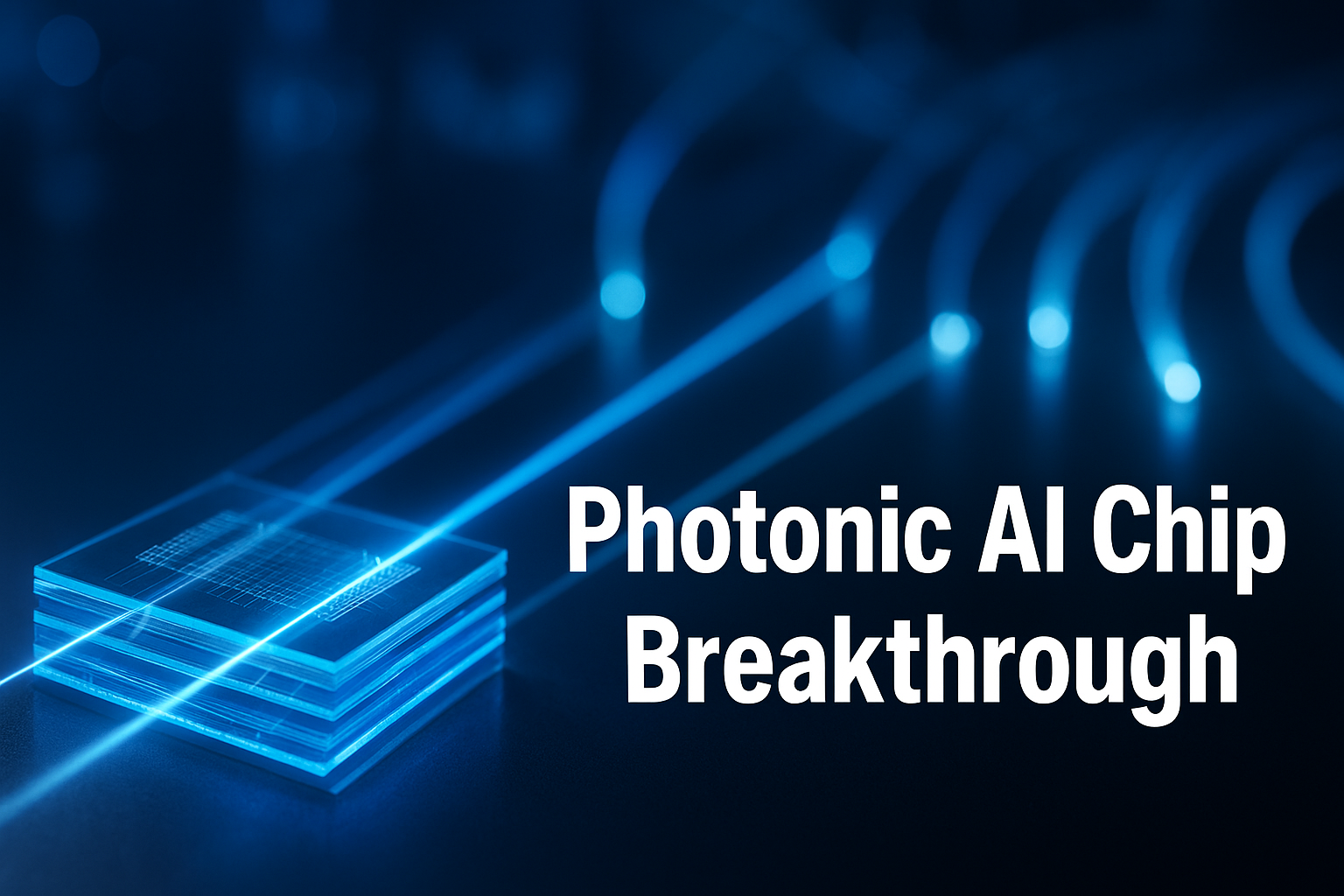
Photonic AI Chip: How Light-Based Processors Are Revolutionizing Artificial Intelligence in 2025
Introduction:
Imagine a computer chip that processes information at the speed of light while consuming a fraction of the energy used by today’s powerful GPUs. This isn’t science fiction—it’s the reality of photonic AI chips transforming the artificial intelligence landscape right now.
Recent breakthroughs from MIT demonstrate fully integrated photonic processors completing machine learning computations in under half a nanosecond with over 92 percent accuracy, matching traditional hardware performance. Meanwhile, Chinese researchers unveiled photonic quantum chips reportedly accelerating complex calculations by more than a thousandfold, marking one of the most significant advances in next-generation computing.
As AI models grow exponentially larger and energy costs skyrocket, the technology industry faces an urgent challenge. Data centers already consume massive amounts of electricity, with some projections suggesting they could account for over 10 percent of power demand within years. Photonic AI chips emerge as the solution—using light particles instead of electrons to process neural networks faster, cooler, and more efficiently than ever before.
What Is a Photonic AI Chip?
A photonic AI chip is a revolutionary processor that uses photons—particles of light—instead of electrical signals to perform artificial intelligence computations. Think of it as replacing the copper wires in your computer with fiber optic cables, but at the microscopic chip level.
Traditional electronic chips move data by pushing electrons through silicon transistors, generating heat and consuming substantial power. Photonic chips manipulate light beams through specially engineered optical components on silicon wafers. Light travels faster, carries more data simultaneously, and generates virtually no heat during transmission.
The core advantage lies in how photonic AI chips handle matrix multiplication—the fundamental mathematical operation powering neural networks. When signal light carrying input data passes through photonic materials, optical components perform computations directly without converting between electrical and optical signals repeatedly.
This direct optical processing eliminates the energy-intensive conversions that plague hybrid systems. The result? Computations happen at light speed with dramatically lower energy consumption and latency.
How Photonic AI Chips Work: The Science Behind Light-Based Computing
Understanding photonic AI chips requires grasping a few key optical principles. These processors leverage fundamental properties of light to perform the mathematical operations that power artificial intelligence.
Optical Neural Networks and Photonic Architecture
Photonic processors are composed of interconnected modules forming optical neural networks, with each module performing specific computations as light passes through engineered structures. These structures include waveguides that channel light, modulators that encode data onto light beams, and photodetectors that read the results.
The breakthrough centers on implementing nonlinear activation functions—critical operations that enable neural networks to learn complex patterns. For years, this represented the biggest challenge in photonic computing. Electronic chips perform these nonlinear operations naturally through transistor switching, but photons don’t interact with each other easily.
Researchers overcame this obstacle by designing nonlinear optical function units combining electronics and optics to implement nonlinear operations directly on the chip. This innovation allows photonic processors to execute complete deep neural network computations without sending data off chip for processing.
Field-Programmable Photonic Technology
Recent advances introduced field-programmable photonic chips using special semiconductor materials that respond to light beams, with a “pump” beam adjusting how signal light carrying input data behaves. By changing the pump beam’s shape and intensity, engineers can reprogram the chip to perform different nonlinear functions.
This programmability represents a game-changer. Earlier photonic systems were fixed after fabrication, limiting their flexibility. The new approach creates a blank canvas where light essentially draws reprogrammable instructions into the material, enabling the chip to adapt to different AI tasks.
3D Integration and Co-Packaging
Modern photonic AI chips employ sophisticated 3D integration techniques. Advanced systems integrate six chips within a single package using high-speed interconnects between vertically aligned photonic tensor cores and control dies, creating extraordinarily dense computing systems.
Some photonic chips pack more than 1,000 optical components onto six-inch silicon wafers using monolithic design, achieving world-class levels of integration. This density, combined with the ability to manufacture chips using commercial foundry processes, makes photonic AI processors practical for real-world deployment.
Breakthrough Performance: Speed and Energy Efficiency
The performance metrics of photonic AI chips are nothing short of remarkable. These devices deliver computational capabilities that seemed impossible just years ago.
Lightning-Fast Processing Speeds
The Optical Feature Extraction Engine developed at Tsinghua University processes data at 12.5 GHz using integrated diffraction operators, enabling unprecedented speed for AI feature extraction tasks. This represents a significant leap beyond traditional electronic approaches.
In wireless signal processing applications, photonic chips operate about 100 times faster than the best digital alternatives while converging to approximately 95 percent accuracy. For time-critical applications like autonomous vehicles or 6G wireless networks, this speed advantage proves transformative.
The optical processing happens so rapidly that it enables real-time deep learning on edge devices—something previously impossible with electronic processors. Applications requiring split-second reactions can now leverage sophisticated AI models directly at the point of data collection.
Dramatic Energy Savings
Energy efficiency represents perhaps the most compelling advantage of photonic AI chips. Advanced photonic processors perform 65.5 trillion operations per second while consuming only 78 watts of electrical power and 1.6 watts of optical power—a fraction of what comparable electronic accelerators require.
Columbia Engineering’s 3D photonic-electronic platform achieves exceptional energy efficiency of just 120 femtojoules per bit while delivering 800 Gb/s bandwidth. This level of efficiency addresses the critical bottleneck in modern AI systems: data movement between processors and memory.
In practical terms, photonic AI chips could reduce data center energy consumption by more than 50 percent compared to current electronic systems. Given the massive and growing power demands of AI infrastructure, these savings translate to both reduced operational costs and environmental benefits.
Accuracy Comparable to Electronic Systems
MIT’s photonic processor achieved more than 96 percent accuracy during training tests and over 92 percent accuracy during inference, demonstrating that optical systems can match traditional hardware precision. This addresses earlier concerns that photonic computing might sacrifice accuracy for speed.
Modern photonic processors execute state-of-the-art neural networks including transformers, convolutional networks, and reinforcement learning algorithms without modifications or special training techniques. They work “out-of-the-box” with existing AI models, eliminating the need for custom optimization.
Real-World Applications of Photonic AI Chips
Photonic AI chips aren’t just laboratory demonstrations—they’re beginning to solve real problems across multiple industries. The unique capabilities of light-based processing enable applications that were previously impractical or impossible.
Data Centers and Cloud Computing
Photonic chips are being positioned for deployment in data centers to handle AI workloads and accelerate classical computation supporting quantum research. The combination of high bandwidth, low latency, and reduced energy consumption makes them ideal for hyperscale computing environments.
Major technology companies are exploring photonic interconnects to connect thousands of GPUs and AI accelerators. The bandwidth density and energy efficiency of optical links solve the critical bottleneck limiting data center scaling. As AI training runs grow larger, optical interconnects become not just advantageous but necessary.
Financial Trading and Market Analysis
Demonstrations in high-frequency trading showed that optical processors deliver improved accuracy, lower latency, and reduced power demand for feature extraction—critical capabilities in financial markets where microseconds matter.
Quantitative trading firms leverage photonic AI chips to analyze market data streams in real-time, identifying patterns and executing trades before competitors. The ultra-low latency enables strategies previously impossible with electronic processors, potentially providing significant competitive advantages.
Healthcare and Medical Imaging
Medical applications benefit enormously from photonic AI’s speed and precision. Advanced imaging techniques like optical coherence tomography combine naturally with photonic processors, enabling real-time analysis of scans during procedures.
Genomic sequencing, drug discovery simulations, and personalized medicine algorithms all involve computationally intensive tasks well-suited to photonic acceleration. The ability to process complex biological data rapidly could accelerate research timelines and improve patient outcomes.
Autonomous Systems and Robotics
Photonic processors enable edge devices to perform deep learning computations in real-time, allowing autonomous vehicles to make split-second reactions to environmental changes. The combination of speed and low power consumption proves ideal for mobile applications.
LiDAR systems integrated with photonic AI chips can process three-dimensional environmental data at unprecedented rates. This enables more sophisticated perception algorithms running directly onboard autonomous vehicles, improving safety and responsiveness.
Wireless Communications and 6G Networks
In 6G wireless applications, photonic accelerators could enable cognitive radios that optimize data rates by adapting modulation formats to changing wireless environments in real-time. The processing speed matches the demands of next-generation communication systems.
Signal classification, beamforming optimization, and interference management all benefit from photonic AI acceleration. As wireless networks grow more complex and data rates increase, optical processing may become essential infrastructure.
Aerospace and Scientific Computing
Photonic quantum chips are already being deployed in industries including aerospace, biomedicine, and finance, demonstrating practical commercial adoption beyond research laboratories.
Astronomical data analysis, particle physics simulations, and climate modeling involve massive computational workloads ideal for photonic acceleration. The energy efficiency proves particularly valuable for space-based applications where power is limited.
Comparing Photonic AI Chips vs Traditional Electronic Processors
Understanding the differences between photonic and electronic AI processors helps clarify when each technology excels and where they complement each other.
Speed and Latency
Photonic chips dramatically outperform electronic processors in raw processing speed for specific operations. Light travels at 300 million meters per second, while electrical signals in copper move at roughly half that speed. More importantly, optical computations happen directly without the clock cycles required in digital electronics.
For tasks involving massive parallel computations—like matrix multiplication in neural networks—photonic processors complete operations in nanoseconds compared to microseconds for electronic alternatives. This speed advantage grows more pronounced as problem size increases.
However, electronic processors still excel at complex logic operations and branching decisions. The flexibility of digital computing makes traditional chips better suited for general-purpose computing tasks requiring frequent conditional logic.
Energy Consumption
The energy efficiency gap between photonic and electronic AI chips is substantial and growing. Electronic processors face fundamental physical limits—moving electrical charges through transistors requires energy that converts to heat, demanding additional power for cooling.
Photonic systems transmit data without moving electrons, eliminating this energy loss. While optical components like lasers and modulators do consume power, the overall system efficiency proves far superior for AI workloads dominated by data movement.
As AI models scale to billions or trillions of parameters, the energy advantage of photonics becomes increasingly critical. Some projections suggest photonic data centers could operate at one-tenth the power consumption of electronic equivalents.
Scalability and Integration
Photonic chips are fabricated using commercial foundry processes identical to those producing traditional computer chips, ensuring manufacturing scalability. This compatibility with existing semiconductor infrastructure represents a crucial advantage over exotic alternative computing technologies.
Integration density continues improving rapidly. Modern designs pack thousands of photonic components alongside electronic circuits on single chips. 3D integration techniques enable even greater component density while managing thermal challenges effectively.
Electronic processors maintain advantages in compact low-power applications where photonic components would be impractical. Smartphones and edge devices with strict size constraints will likely rely on electronic processors for the foreseeable future, though photonic accelerators may supplement them.
Challenges Facing Photonic AI Chip Technology
Despite impressive progress, photonic AI chips face significant technical and commercial hurdles before achieving widespread adoption. Understanding these challenges helps set realistic expectations.
Manufacturing Complexity and Cost
While photonic chips use commercial foundries, the manufacturing processes differ from standard electronic chip production. Integrating optical and electronic components requires specialized equipment and expertise. Quality control proves more challenging because optical defects can severely impact performance.
Initial production costs exceed those of electronic AI accelerators. As manufacturing volumes increase and processes mature, costs should decline significantly. However, achieving price parity with high-volume GPU production will take time and substantial investment.
Integration with Existing Systems
Most near-term photonic AI deployments will be hybrid systems combining optical accelerators with electronic processors and memory. This requires careful system architecture to minimize conversions between optical and electrical domains.
Software frameworks, development tools, and programming models optimized for electronic processors must be adapted for photonic hardware. Building this ecosystem requires collaboration across the industry and education of developers on photonic computing principles.
Limited Programmability and Flexibility
While recent advances introduced field-programmable photonic chips, these devices still offer less flexibility than fully programmable electronic processors. Certain operations remain challenging to implement efficiently in optical hardware.
Electronic processors can execute arbitrary code through software, whereas photonic accelerators work best for specific computational patterns. This limits their applicability to well-defined AI workloads rather than general computing tasks.
Thermal Management and Stability
Although photonic transmission generates minimal heat, components like lasers and photodetectors do produce thermal output. Managing temperature gradients across chips proves critical because optical properties of materials change with temperature.
Maintaining precise wavelength control and timing synchronization requires sophisticated thermal management. Environmental factors affecting optical properties must be carefully controlled in production systems.
The Future of Photonic AI Chips: What’s Next?
The trajectory of photonic AI chip development suggests transformative changes ahead. Multiple technological trends are converging to accelerate adoption and expand capabilities.
Commercial Deployment Timeline
Industry experts anticipate broader commercial deployment of photonic AI accelerators beginning in 2025-2027, initially targeting hyperscale data centers and high-performance computing facilities. Advanced manufacturing facilities can already produce 12,000 six-inch wafers annually, demonstrating production readiness.
By 2028-2030, photonic components should become standard in AI infrastructure. Data center operators will increasingly deploy optical interconnects and accelerators to manage growing AI workloads sustainably. Early adopters gaining experience today will have significant competitive advantages.
Integration with Quantum Computing
Photonic chip architectures are designed with flexibility to scale toward systems supporting millions of qubits—the quantum computing units. The convergence of photonic and quantum technologies creates exciting possibilities.
Photonic AI chips can accelerate certain quantum algorithms while quantum systems tackle problems beyond classical computers. This symbiotic relationship may define the next era of computing, combining the strengths of multiple technologies.
AI-Photonics Synergy
An intriguing development involves using AI to optimize photonic systems themselves. Machine learning algorithms compensate for nonlinear distortions and enable higher transmission rates in silicon photonic systems, creating a positive feedback loop.
AI-designed photonic components may achieve performance levels impossible through traditional engineering approaches. This synergy between AI and photonics promises continued rapid innovation.
Emerging Applications
As photonic AI chips mature, new applications will emerge. Brain-computer interfaces, real-time holographic displays, and ultra-secure quantum communication networks all could leverage photonic AI acceleration.
Medical devices using photonic processors might provide continuous health monitoring with sophisticated AI analysis running on battery power. Wearable devices could gain capabilities currently limited to cloud-connected systems.
Expert Perspectives and Industry Investment
The photonic AI chip sector is attracting substantial investment and attention from technology leaders worldwide. This momentum signals confidence in the technology’s commercial viability.
Venture Capital and Corporate Funding
Companies in the photonic computing sector have achieved valuations reaching $4.4 billion, reflecting strong investor confidence. Venture capital flowing into photonic startups has accelerated dramatically over the past two years.
Major technology companies are establishing internal photonic computing programs. The strategic importance of energy-efficient AI infrastructure drives this investment, as power consumption threatens to limit AI progress without breakthrough solutions.
Academic Research Momentum
Universities worldwide are establishing photonics research centers and expanding programs. Studies published in leading journals demonstrate photonic platforms achieving 290 times greater footprint-energy efficiency than other photonic approaches and 140 times better than advanced digital electronics.
Collaboration between academia, national laboratories, and industry accelerates innovation. Government funding supports fundamental research while companies focus on commercialization, creating a healthy ecosystem for technology development.
Global Competition and Cooperation
International competition in photonic AI technology is intensifying, particularly between the United States and China. Both nations recognize photonic computing’s strategic importance for maintaining technological leadership.
Simultaneously, global cooperation on standards and manufacturing practices helps accelerate adoption. Open research sharing and collaborative projects ensure the technology develops robustly and benefits the broader scientific community.
Frequently Asked Questions About Photonic AI Chips
Q.1 What makes photonic AI chips faster than traditional electronic processors?
Ans. Photonic AI chips process information using light particles that travel at 300 million meters per second and can perform computations in parallel without clock cycles. Unlike electronic processors that must sequentially switch transistors on and off, optical systems complete matrix operations—the core of AI computations—in nanoseconds by manipulating light beams through specially engineered structures.
Q.2 Can photonic AI chips completely replace GPUs for artificial intelligence?
Ans. Not entirely. Photonic chips excel at specific AI workloads like neural network inference and training involving massive parallel matrix operations. However, general-purpose computing, complex logic operations, and applications requiring frequent branching decisions still favor electronic processors. The near-term future involves hybrid systems combining photonic accelerators with traditional electronic processors.
Q.3 How much energy do photonic AI chips save compared to electronic alternatives?
Ans. Energy savings vary by application but can be dramatic. Advanced photonic processors consume as little as one-tenth the power of equivalent electronic AI accelerators. In data center applications, photonic interconnects and accelerators could reduce overall energy consumption by 50 percent or more, addressing one of AI infrastructure’s most critical challenges.
Q.4 When will photonic AI chips become widely available commercially?
Ans. First-generation photonic AI accelerators are entering commercial deployment in 2025-2027, initially for hyperscale data centers and specialized high-performance computing applications. Broader adoption across industries should occur by 2028-2030 as manufacturing scales up, costs decline, and software ecosystems mature. Consumer applications will likely follow several years later.
Q.5 What are the biggest limitations of photonic AI chip technology today?
Ans. Key challenges include higher initial manufacturing costs compared to mature electronic chip production, complexity of integrating optical and electronic components on single chips, limited programmability compared to fully software-defined processors, and the need to develop new software frameworks and tools. Additionally, certain types of computations remain more efficiently performed electronically than optically.
Q.6 How do photonic AI chips handle the nonlinear operations essential for deep learning?
Ans. This was historically the biggest challenge in photonic computing. Recent breakthroughs introduced nonlinear optical function units that combine electronic and optical elements to implement activation functions directly on photonic chips. Other approaches use special semiconductor materials where pump light beams dynamically reprogram how signal light behaves, enabling programmable nonlinear operations at light speed.
Conclusion: The Dawn of Light-Powered Intelligence
Photonic AI chips represent more than an incremental improvement in computing technology—they herald a fundamental transformation in how we process information. By harnessing light’s unique properties, these revolutionary processors deliver the speed, efficiency, and scalability required for artificial intelligence’s next chapter.
The breakthroughs of 2024 and 2025 have moved photonic AI from laboratory curiosity to commercial reality. Chips processing neural networks at light speed while consuming a fraction of traditional power are no longer distant promises but deployed systems solving real problems.
As AI models continue their exponential growth, the sustainability and cost challenges of electronic computing become untenable. Photonic AI chips offer a path forward—enabling more powerful artificial intelligence without proportional increases in energy consumption or infrastructure costs.
For researchers, investors, and technology leaders, the message is clear: photonic AI is transitioning from emerging technology to essential infrastructure. Those who understand and embrace this shift will shape the next era of artificial intelligence. The age of light-powered computing has arrived.
Stay ahead of the AI revolution—share this article and explore how photonic computing is transforming technology in 2025!


It is actually a great and helpful piece of information. I’m satisfied that you just shared this useful info with us. Please keep us informed like this. Thank you for sharing.